
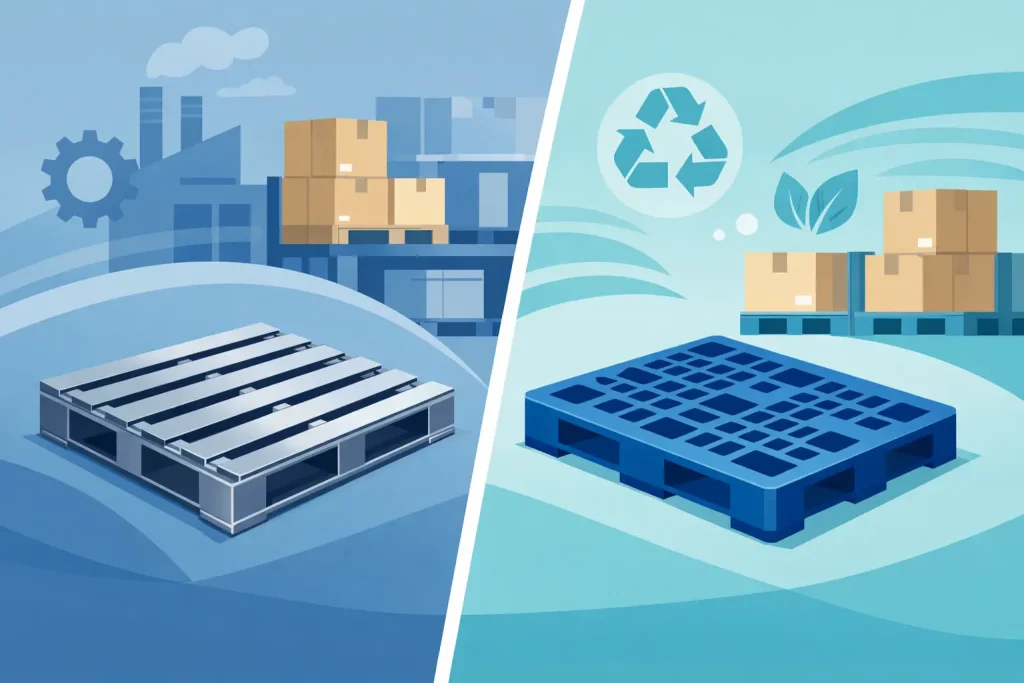
A pallet choice usually looks simple until it starts affecting damage rates, cleanup time, storage rules, and replacement costs. When buyers compare steel pallets vs plastic pallets, the right answer depends less on preference and more on what the pallet will carry, where it will sit, and what risks your site needs to control.
For warehouses, plants, workshops, chemical handling areas, and loading operations, pallets are not just transport platforms. They are part of the safety setup, the storage system, and the operating budget. Choosing the wrong material can create handling problems, hygiene issues, early breakage, or poor performance in spill-sensitive areas.
Steel pallets vs plastic pallets: what really changes
The biggest difference is not just material. It is how each pallet behaves under real industrial pressure.
Steel pallets are typically selected for heavy loads, hard use, and applications where structural strength matters most. They perform well in demanding environments where pallet damage is common, stacking loads are significant, or the goods being stored are dense and unforgiving. In many industrial settings, steel gives buyers confidence because it resists warping, cracking, and impact better than lighter alternatives.
Plastic pallets, by comparison, are often chosen for cleaner environments, easier washdown, and operations that need consistent dimensions with lower maintenance. They are common in food handling, pharmaceuticals, general warehousing, and areas where moisture, corrosion, or hygiene standards play a bigger role than extreme load stress.
That is why the better question is not which one is best overall. It is which one fits your operation with fewer compromises.
Load capacity and structural strength
If your site handles heavy machinery parts, drums, metal products, bagged raw materials, or dense industrial stock, steel pallets usually have the advantage. They are built for high static loads and repeated hard handling. Forklift contact, rack storage pressure, and outdoor use tend to punish pallets over time, and steel generally holds its form under that punishment.
This matters in operations where a pallet failure is not a small inconvenience. A broken pallet under a heavy load can damage stock, delay movement, and create a safety issue for operators.
Plastic pallets can still handle substantial loads, but performance varies widely by design, resin quality, and intended use. Some are excellent for medium-duty or even heavy-duty applications, while others are meant only for export or one-way shipping. That range can be a strength or a weakness. It gives buyers options, but it also means you need to match the pallet specification closely to the real load, not the ideal load on paper.
If your operation is rough, repetitive, and heavy, steel usually gives more margin for error.
Hygiene, washdown, and contamination control
Plastic pallets are often the easier choice when hygiene is a priority. Their surfaces are easier to clean, they do not absorb moisture, and they are suitable for wet environments where regular washdown is part of standard practice. For pharmaceutical, healthcare, food-related, or lab-linked operations, that can make plastic a practical fit.
Steel pallets can also be cleaned effectively, especially in controlled industrial environments, but they may require more attention depending on finish, coating, and exposure conditions. If corrosion develops or the surface is damaged, maintenance becomes part of the equation.
In spill-control settings, plastic also has a clear practical advantage when chemical exposure or frequent liquid contact is expected. It resists many forms of moisture-related deterioration and is commonly used in spill containment pallets for exactly that reason. If a site is handling oils, chemicals, or fluid containers where leaks are possible, plastic solutions often align better with containment planning.
Corrosion resistance and environmental exposure
Steel pallets are strong, but environment matters. In dry indoor operations, they can deliver long service life with very good durability. In humid, wet, or chemically exposed areas, however, corrosion risk needs to be considered. Galvanized or coated steel can improve resistance, but buyers should still assess actual site conditions rather than assume steel will suit every environment.
Plastic pallets do not rust, which is one reason they are so widely used in wet handling zones, wash areas, and locations with frequent fluid exposure. If your facility deals with water, cleaning chemicals, oils, or outdoor humidity, plastic may reduce maintenance headaches.
That said, plastic has its own limits. In some environments with extreme heat, heavy impact, or prolonged UV exposure, lower-grade plastic pallets can degrade faster than expected. Material quality matters. A cheap pallet that looks acceptable on delivery can become expensive if it starts cracking in service.
Weight, handling, and transport efficiency
Plastic pallets are generally lighter than steel, and that affects day-to-day handling. Operators may find them easier to move manually when empty, and lighter pallet weight can help reduce shipping weight in transport-heavy applications. For export, distribution, and high-turnover logistics, that can support cost control.
Steel pallets are heavier, which can be a disadvantage in some workflows. They are less convenient where pallets are moved often when empty, and their added weight may increase transport burden in certain supply chains. But that same weight can also support stability for specific industrial storage needs.
If your pallets stay mostly in one facility and carry heavy product, the extra weight may not matter much. If they are constantly moving through freight networks, it probably will.
Durability, damage patterns, and service life
One reason industrial buyers choose steel is predictability under harsh use. Steel pallets do not usually fail in the same way plastic pallets can. Instead of cracking from impact or splitting under repeated stress, steel tends to show wear more gradually, assuming the pallet is properly built and maintained.
Plastic pallets resist moisture and many chemicals well, but impact damage can be an issue in rough forklift environments. Cold storage conditions can also make some plastic pallets more brittle, depending on material grade. In cleaner operations with disciplined handling, plastic can last very well. In high-abuse environments, replacement frequency can rise quickly.
This is where purchase price alone can mislead procurement teams. A lower-cost pallet is not cheaper if it needs to be replaced far more often.
Cost: upfront price vs operating cost
Plastic pallets often offer a lower entry cost than steel pallets, especially in standard warehouse applications. That makes them attractive for buyers managing immediate budget pressure or large pallet quantities.
Steel pallets usually cost more upfront, but they may provide better long-term value where breakage, load stress, or harsh handling destroys lighter pallets too quickly. The cost decision should include expected lifespan, damage rate, maintenance, and the operational cost of pallet failure.
There is also a middle ground many buyers overlook. If the application is low-risk and budget-sensitive, second-hand plastic pallets can be a practical option for certain storage or internal movement tasks. But they should be used selectively. For safety-critical, heavy-load, or spill-sensitive applications, buyers should focus on fit-for-purpose performance first.
Steel pallets vs plastic pallets for spill-control areas
For spill-control and chemical handling areas, plastic often makes more sense, especially where the pallet is part of a containment strategy or sits near drums, pails, and liquid containers. Plastic handles wet conditions well and is widely used in spill containment systems because it supports cleanup and resists corrosion.
Steel pallets can still be useful in industrial zones where load strength is the main concern and liquid exposure is limited or controlled. But if your pallet will operate near frequent leaks, washdowns, or chemical storage, plastic is usually the more practical direction.
This is especially relevant for EHS officers and facility managers trying to reduce contamination risk while keeping storage organized. The pallet material should support both handling performance and response readiness.
Which pallet is right for your operation?
Choose steel pallets if your site deals with very heavy loads, repeated forklift impact, rack pressure, or demanding industrial handling where structural strength matters more than light weight or washdown convenience.
Choose plastic pallets if your operation prioritizes hygiene, moisture resistance, easier cleaning, spill-control compatibility, or lower handling weight. They are often the better fit for general warehousing, clean environments, and liquid-related storage areas.
If your operation includes both heavy-duty logistics and spill-risk zones, the smartest choice may be using both. Many facilities standardize plastic pallets for chemical storage, washdown areas, and general movement, while keeping steel pallets for dense loads and punishing industrial use.
That is usually how practical buyers make the decision – not by asking which material wins, but by matching each pallet to the job it has to survive. If you are ordering for real site conditions, not just a catalog spec sheet, you will make a better buying decision and avoid paying twice for the wrong pallet.