
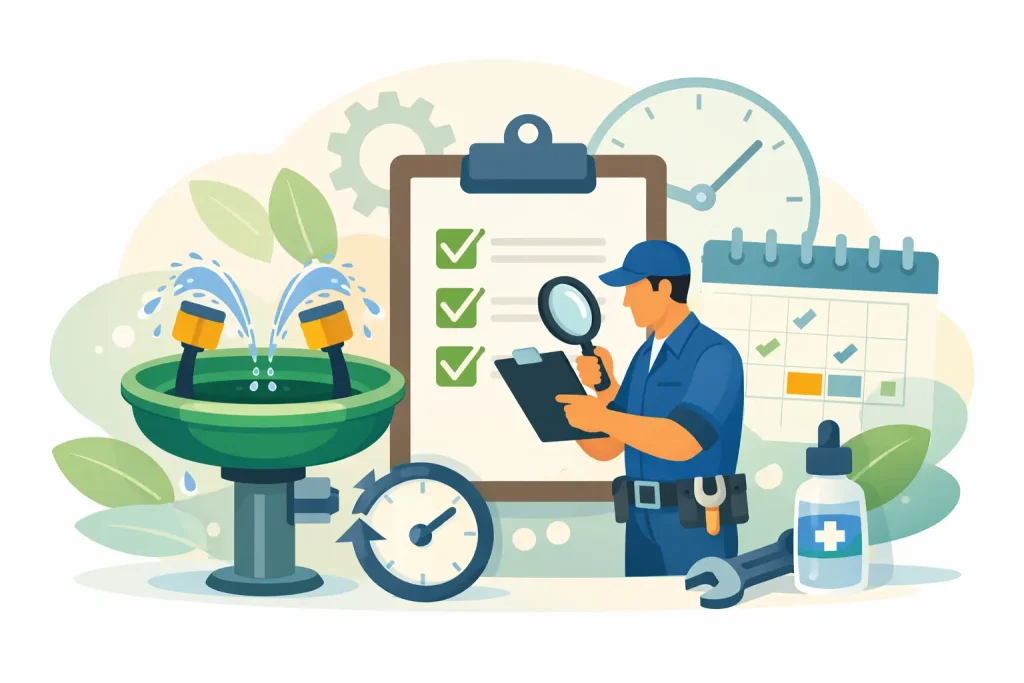
When an employee gets a chemical splash in the eye, nobody has time to wonder whether the unit was tested last week or whether the water is still clean. An eyewash station maintenance schedule exists for one reason – the equipment must work immediately, every single time. For EHS teams, plant managers, and procurement leads, that means treating eyewash inspection as an operating requirement, not a box to tick.
A good schedule does more than support compliance. It reduces failure risk, keeps stagnant water from becoming a problem, and gives your team a clear routine that is easy to assign and verify. In busy facilities, that consistency matters just as much as the equipment itself.
Why an eyewash station maintenance schedule matters
Eyewash stations sit idle for long periods, which is exactly why maintenance gets overlooked. The problem is that emergency equipment can look fine from a distance and still fail when used. Dust can block spray heads, valves can stick, flow can weaken, and self-contained units can run low or go out of date.
That is the practical risk. The compliance risk is separate, but just as real. If a station is installed in a chemical handling area, a lab, a warehouse with battery charging, or a maintenance shop, it needs regular inspection and testing. If records are missing or checks are inconsistent, the site is exposed during an audit or after an incident.
The right schedule keeps things simple. Your team knows what to inspect daily, what to test weekly, what to review monthly, and what to service on a longer cycle. That structure helps avoid the common problem of doing one large inspection too late instead of smaller checks on time.
What to include in your eyewash station maintenance schedule
The schedule should match the station type, site conditions, and level of exposure. A plumbed eyewash in a clean indoor lab does not face the same issues as a portable eyewash station in a hot, dusty workshop. The timing can be similar, but the inspection detail may need to be stricter in harsher environments.
Daily or shift-based checks
Not every facility needs a formal daily inspection, but many high-traffic or high-risk sites should use one. This is usually a quick visual check by operations or supervisory staff. The goal is access and obvious readiness.
Confirm the area around the station is clear. There should be no pallets, boxes, tools, drums, or waste bins blocking access. Check that signage is visible and lighting is adequate. If the unit has protective covers, make sure they are in place and not damaged.
For self-contained units, this is also the right time to look for leaks, low fluid level, or obvious contamination. In hot environments, evaporation and heat exposure can create problems faster than many teams expect.
Weekly activation and flushing
Weekly testing is the part most facilities know about, and for good reason. Plumbed eyewash stations should typically be activated weekly to verify operation and flush the line. This helps clear sediment, confirms the valve opens properly, and reduces stagnant water in the piping.
During the test, check that the unit starts quickly, the spray pattern is even, and the flow reaches both eyes at the same time. The water should not be so strong that it can injure the user, but it must be strong enough to flush effectively. Let the unit run long enough to confirm stable performance and line flushing.
This is also the time to inspect dust covers, nozzles, drain function, and obvious corrosion. If the station is in a dirty production area, weekly checks may need extra attention because airborne particles and residue can build up fast.
Monthly inspection
A monthly review goes beyond activation. This is where you verify the unit as an asset, not just a water source. Check the body, fittings, bowl, mounting, and surrounding area for wear, rust, impact damage, or tampering. Review whether signage is still visible from normal approach paths.
For self-contained eyewash units, inspect the solution status, expiry date if applicable, and manufacturer guidance for cleaning and replacement. Some sites make the mistake of topping up old fluid without a proper drain and refill. That may save a few minutes, but it can create hygiene and performance issues later.
Monthly inspections are also a good time to verify records. If weekly logs are missing, unsigned, or incomplete, fix the process before it becomes routine. A schedule only works if someone owns it.
Different station types need different timing
Plumbed and self-contained units should not be managed exactly the same way. Both need regular checks, but the failure points are different.
Plumbed eyewash stations depend on water supply, valve operation, and line condition. They benefit from regular flushing because stagnant water is the main concern. If your facility has old piping, hard water, or inconsistent pressure, inspection quality becomes even more important.
Self-contained units depend on stored fluid condition, fill level, cleanliness, and replacement intervals. They are useful for remote work areas, temporary operations, and sites where plumbing access is limited, but they need stricter fluid management. If nobody tracks refill and replacement dates, the unit can become unreliable without looking obviously defective.
Combination emergency shower and eyewash units also deserve added attention. These units cover multiple exposure risks and are often installed in process areas with corrosive materials. A weak shower flow, blocked eyewash nozzle, or damaged pull handle can all turn into a serious response failure.
Common mistakes that weaken your schedule
The most common mistake is assuming installation equals readiness. Once the unit is mounted, teams often move on. Months later, they realize the access path is blocked, the inspection tag is blank, or the station has not been activated in weeks.
Another mistake is using a one-size-fits-all schedule across every building. That sounds efficient, but it can miss local conditions. A clean indoor pharmaceutical area and an outdoor fabrication yard have very different maintenance demands. Site-specific adjustments are usually worth it.
Recordkeeping is another weak point. A verbal check is not enough. If a station was tested, cleaned, repaired, or taken out of service, there should be a clear log. During an incident review, missing paperwork often becomes its own problem.
Teams also forget to connect eyewash maintenance with hazard changes. If a new chemical process is added, if a wash bay is relocated, or if a warehouse starts handling battery systems, the maintenance schedule may need to change along with the risk.
How to build a schedule your team will actually follow
Start with an equipment list. Identify every eyewash station by location, type, and hazard area. Then assign responsibility by role, not by assumption. If nobody is clearly accountable, inspections will become inconsistent during busy periods, shift changes, or staff turnover.
Keep the inspection form short enough to use in real conditions. If the checklist is too long, people rush it or skip it. Focus on flow, accessibility, cleanliness, condition, and documentation. Add site-specific notes only where they matter.
It also helps to align the schedule with existing routines. Weekly eyewash activation can be paired with spill kit checks, emergency shower inspections, or area safety walks. That reduces missed tasks and makes compliance easier to manage across multiple assets.
Digital tracking can help, but only if the site uses it consistently. Some facilities do better with a simple physical tag and a central log sheet. Others prefer QR-based records and automated reminders. The best system is the one your supervisors will actually maintain under production pressure.
If you are ordering new units or replacing damaged ones, buy with maintenance in mind. Readily available parts, clear operating labels, and dependable construction reduce long-term headaches. For industrial buyers managing multiple safety items, suppliers such as FUMiKA can support faster replacement planning and practical product selection without adding unnecessary complexity.
When to repair, replace, or upgrade
Not every issue needs full replacement. A missing cover, worn sign, or minor valve issue may be easy to correct. But some conditions should trigger a stronger response. Corrosion on critical components, unreliable flow, cracked parts, repeated leakage, or poor placement in relation to the hazard area can justify replacement or relocation.
Upgrade decisions also depend on the site. If a remote work area still relies on an undersized or poorly maintained portable unit, it may be time to switch to a better self-contained model or install plumbed equipment. If your operation has expanded, the original station count may no longer match the exposure risk.
The best maintenance schedule is not the most complicated one. It is the one that keeps emergency equipment clean, accessible, tested, and trusted by the people who may need it without warning. If your current routine leaves gaps, fix the schedule before the next incident tests it for you.