
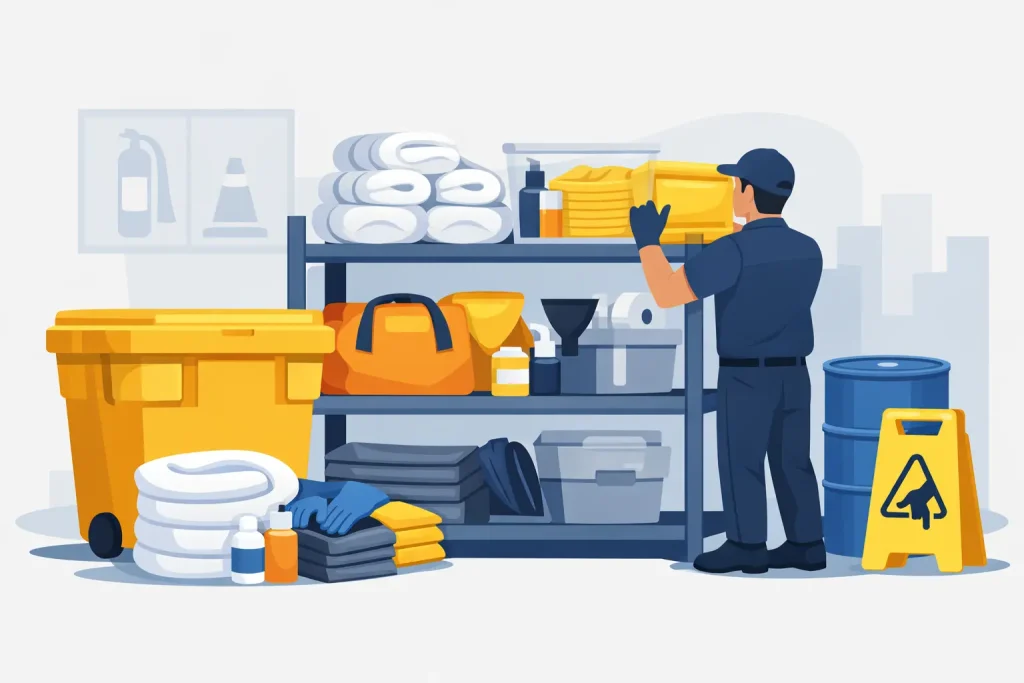
A spill kit that sits in the wrong place is almost as bad as not having one at all. If your team loses five minutes looking for absorbent pads, PPE, or drain covers during a leak, that delay can turn a small incident into damaged stock, a slip hazard, or a reportable event. That is why knowing how to store spill kits matters just as much as choosing the right kit size.
For most sites, proper storage comes down to three things: access, protection, and fit for the hazard. The kit has to be close enough to the risk area, protected from weather and damage, and matched to the liquids handled on site. Miss one of those, and response time suffers.
How to store spill kits for fast access
The best storage location is the one people can reach immediately during a real spill. In a warehouse, that usually means near loading bays, chemical storage zones, battery charging areas, maintenance corners, and forklift traffic routes. In a plant or workshop, it may be near pumps, drums, transfer points, mixing stations, and waste storage.
Do not store spill kits inside locked rooms unless that room is staffed and open whenever operations are active. A locked door creates delay. The same applies to stacking boxes or pallets in front of the kit. If staff have to move inventory before they can open the container, the kit is not truly accessible.
Visibility matters too. A spill kit should be easy to spot from a distance, especially in busy production or logistics areas. Clear signage helps, but placement does most of the work. Put the kit where operators already expect emergency equipment to be, such as near fire extinguishers, eyewash stations, or hazard control points.
If your site is large, one central spill kit is rarely enough. A single 240L unit may hold more material, but it can still be too far away from a remote process line or outdoor transfer point. In many cases, several smaller kits placed closer to specific hazards give faster and more practical coverage than one large station.
Match the storage point to the spill risk
Different work areas need different kit types and capacities. That affects where and how you store them. Oil spill kits are typically placed near fuel storage, vehicle service zones, marine areas, and machinery spaces. Chemical spill kits belong near corrosives, solvents, cleaning chemicals, and lab handling points.
Capacity also changes the storage decision. A 20L or 60L kit can work well in vehicles, compact workshops, and low-volume handling areas. A 120L or 240L kit is better suited to warehouses, plants, loading areas, and facilities with higher spill potential. Bigger is not always better if the unit ends up being too bulky for the actual work zone.
This is where many sites get it wrong. They buy one large spill kit for compliance, place it in a general store, and assume the job is done. In practice, that may satisfy a purchase list but not a response plan. Storage should reflect where spills are likely to happen, not just where there is empty floor space.
Keep spill kits protected, not hidden
A spill kit needs protection from dust, rain, direct sunlight, forklifts, and rough handling. But protection should never come at the cost of access. If you store kits outdoors, use weather-resistant containers and place them on stable ground away from standing water. If possible, position them under cover near the hazard area rather than fully exposed at the edge of the yard.
Indoor kits should stay away from heat sources, welding sparks, and high-traffic impact zones unless they are guarded from damage. It is common to see spill kits placed near roller doors where forklifts keep clipping the container. That creates its own safety problem and can damage absorbents or PPE before they are ever used.
Storage height matters as well. Small kits can be wall-mounted or placed on shelving if they remain easy to remove. Larger wheeled bins should stay at floor level with a clear path around them. Staff should not need a ladder, a pallet jack, or extra manpower just to get a spill kit into position.
How to organize spill kit storage inside the container
Knowing how to store spill kits is not only about where the bin sits. It also includes how the contents are arranged inside. When a spill happens, people should be able to open the kit and identify what they need immediately.
Keep absorbent pads, socks, pillows, disposal bags, and PPE organized by function. Heavy use items should be most visible and easiest to grab first. If the kit includes instructions or a response card, place it where it can be seen right away, not buried under loose absorbents.
Do not use spill kits as general storage bins. It sounds obvious, but on active sites, emergency containers often become convenient places for gloves, rags, tape, or random maintenance items. That habit creates confusion during an incident and can leave the actual spill response materials incomplete.
After every use, restock the kit immediately. A half-empty kit in the correct location still leaves your team underprepared. Assign responsibility clearly, whether that sits with EHS, maintenance, stores, or shift supervision. If nobody owns the check, the kit will eventually fail.
Inspection is part of storage
Proper storage includes routine inspection. A spill kit can look fine from the outside while key items inside are missing, soaked, contaminated, or expired. Set a regular inspection schedule based on your site risk, traffic level, and exposure conditions. Monthly checks are common, but high-risk areas may need more frequent review.
Look at the container condition, labeling, lid closure, wheel function if applicable, and the contents list. Confirm the kit still matches the hazard in that area. Processes change over time. A maintenance room that once handled mostly oils may now store stronger cleaning chemicals, which can mean the original kit type is no longer the right fit.
This is also the right time to check nearby support equipment. Spill kits work better when paired with practical containment tools such as spill pallets, drain protection, and absorbent refills kept close by. If your operation stores drums or IBCs, primary response and secondary containment should be planned together, not separately.
Common mistakes when storing spill kits
The first mistake is placing kits too far from the actual hazard. The second is blocking them with stock, pallets, or equipment. The third is choosing one generic location for the whole building instead of positioning kits by risk zone.
Another common issue is storing the wrong kit in the wrong area. A general-purpose kit near aggressive chemicals can create a poor response outcome. The same goes for undersized kits in areas where a spill can spread fast across a wide floor area.
Some businesses also overlook training. Even if you know how to store spill kits correctly, your team still needs to know where they are, what they contain, and when to use them. During an actual spill, people fall back on habit. If the kit location and layout are not already familiar, response slows down.
A practical storage setup by facility type
In a warehouse, place larger kits near receiving, dispatch, battery charging, and liquid storage. Keep smaller support kits near high-movement forklift zones if leaks from equipment or pallets are possible. In workshops, position kits close to oils, coolants, and service bays, with outdoor coverage if vehicles are parked or serviced outside.
In laboratories and healthcare areas, store chemical-specific kits near handling benches, chemical stores, and waste points, but not where a spill could immediately contaminate the kit itself. In manufacturing plants, divide coverage by process zone so operators do not need to cross production areas carrying absorbents and disposal bags.
For outdoor yards, fuel points, and marine operations, weather protection becomes more important. Use durable containers and inspect more often because sunlight, rain, and dirt break down materials faster. If there is any chance of larger leaks from stored containers, combine spill kit placement with containment pallets and clear emergency access lanes.
Businesses that need ready-stock spill response products, from compact 20L units to 240L kits and absorbent refills, usually get better results when they standardize storage by area and keep replenishment simple. That is the practical advantage of buying from a supplier that understands industrial site use, not just catalog listings.
Good spill kit storage is simple when the setup matches the job. Put the right kit near the real hazard, protect it without hiding it, inspect it before there is a problem, and make sure your team can reach it without hesitation. That is what turns a spill kit from a box on the floor into equipment that actually protects your operation when the pressure is on.