
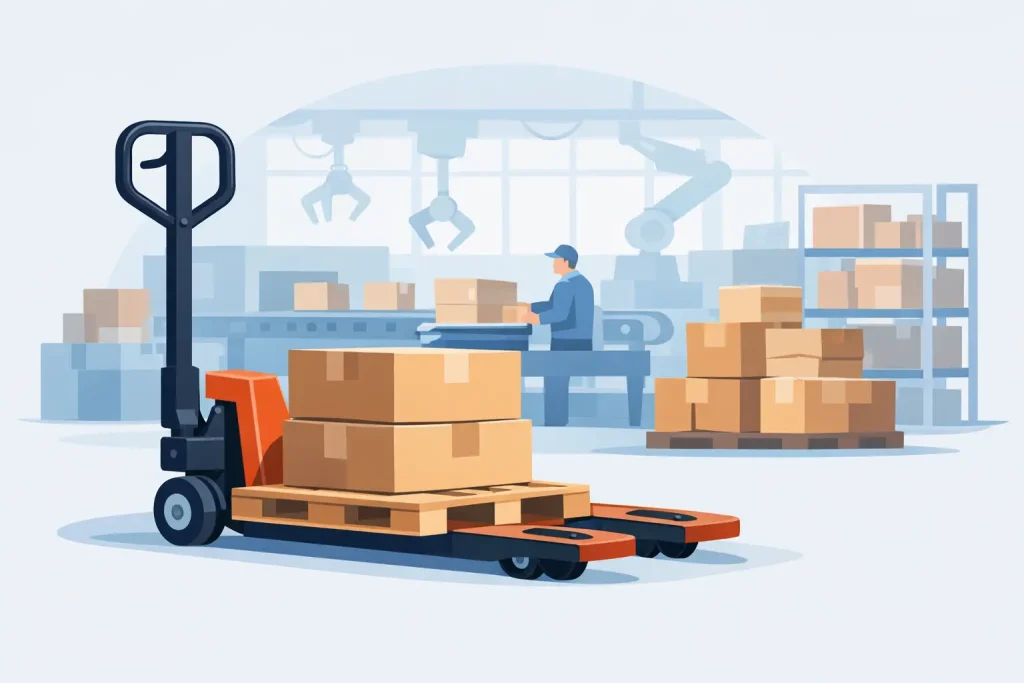
A hand pallet truck for factory work usually gets attention only when it slows the line, damages pallets, or makes operators work harder than they should. In busy production areas, loading bays, and internal transfer routes, that is a costly mistake. The right unit helps move stock faster, reduces handling strain, and supports safer daily operations without adding unnecessary cost.
Factories rely on simple equipment that can take daily abuse and keep moving. That is why hand pallet trucks remain a standard tool across manufacturing, packaging, assembly, maintenance, and warehouse areas. They are easy to use, affordable to maintain, and practical for short-distance pallet movement where a forklift is too large, too expensive, or simply unnecessary.
Why a hand pallet truck for factory operations still matters
In many facilities, not every load needs powered handling equipment. A manual pallet truck is often the better fit for moving finished goods to staging zones, transferring raw materials between workstations, or unloading lighter palletized items from trucks and containers. It gives operators quick access to pallet movement without waiting for a forklift or assigning a licensed driver.
That matters more than many buyers realize. Every delay between production, storage, and dispatch adds labor cost and creates congestion. A properly selected hand pallet truck keeps those short internal movements efficient. It also gives smaller teams more flexibility during peak periods, especially in factories where floor space is tight and routes are shared with people, carts, and other equipment.
The key point is simple. A pallet truck is not just a basic product. In a factory environment, it is part of the workflow. If you choose the wrong one, the problems show up fast.
What to check before buying a hand pallet truck for factory use
Capacity is the first checkpoint, but it should not be the only one. Many buyers look at the rated load and stop there. That can lead to the wrong purchase, because two trucks with the same capacity may perform very differently on your floor.
A standard 2.5-ton model suits many industrial sites, but actual load handling depends on pallet quality, load distribution, route distance, and floor condition. If your pallets are consistently heavy, stacked high, or handled across uneven surfaces, choosing a higher-capacity model gives more stability and service life. On the other hand, buying too heavy a unit for light-duty work can make daily handling less efficient and increase operator effort.
Fork size is just as important. Standard fork dimensions work well for common pallet formats, but factories do not always use standard pallets. Chemical drums on pallets, machine parts, export skids, and narrow packaging pallets may require different fork widths or lengths. If the fork does not fit the pallet correctly, operators waste time repositioning and risk damaging the load.
Lowered and raised fork height also matter. A truck with the wrong entry height may struggle with low-clearance pallets or certain warehouse racking transfer points. Buyers should check the actual pallet opening and floor transition areas before ordering.
Floor conditions decide wheel performance
Wheel material has a direct impact on ease of movement, noise, floor protection, and durability. This is where many low-price purchases go wrong.
Nylon wheels are common for heavy-duty use because they roll well under load and resist wear. They are a strong option for smooth, hard floors in dry factory areas. The trade-off is noise and a harsher ride, especially where floors are rough or joints are frequent.
Polyurethane wheels are often preferred where buyers want quieter movement, better traction, and less floor marking. They can also give operators smoother handling across finished surfaces. The trade-off is that wheel life may vary depending on debris, floor damage, and load weight.
Rubber-type options may suit lighter-duty areas where noise control is more important, but they are not always the best choice for heavier industrial handling. The right answer depends on your site. If the truck will move through production zones, warehouses, and loading areas with mixed floor conditions, wheel selection should be based on the roughest route, not the cleanest one.
Match the truck to the actual factory task
Not all pallet movement in a factory is the same. A unit used in dispatch has different demands from one used in raw material staging or maintenance support.
If the truck is mainly for loading and unloading, buyers should focus on durability, stable steering, and easy pallet entry. If it will be used inside production areas, maneuverability and lower rolling resistance may matter more. In narrow aisles or between machinery, turning radius becomes a practical buying factor, not a specification to ignore.
Usage frequency also changes what makes sense. For occasional movement, a standard model may be enough. For repeated use across every shift, stronger hydraulics, better wheel quality, and a more durable frame usually offer better value over time. Cheap equipment becomes expensive when downtime interrupts production.
Factories with wet areas, washdown zones, food handling sections, or corrosive exposure should also think about material finish and maintenance requirements. A standard painted steel truck may be acceptable in dry indoor environments, but it may not be the best fit everywhere.
Safety is part of the buying decision
A hand pallet truck may seem low-risk compared with powered equipment, but poor selection still creates workplace hazards. Strain injuries, crushed feet, unstable loads, and damaged goods often start with the wrong tool for the job.
A truck that requires excessive push force increases fatigue. A unit with poor wheels can jerk suddenly on rough floors. Forks that do not sit properly under the pallet can lead to partial lifting and load shift. Weak hydraulics may lower inconsistently, which is a problem when handling fragile stock or heavy components.
For factories already managing spill risks, pedestrian routes, and emergency access, manual handling equipment should support the same safety standard as other site purchases. That means looking at stable construction, consistent lifting performance, and suitability for the route. It also means training operators to use the truck correctly rather than treating it as self-explanatory equipment.
Common buying mistakes
The most common mistake is buying only on price. Cost matters, especially for bulk orders or multi-site replacement, but the cheapest model is rarely the lowest-cost option over the full service period. Premature wheel wear, hydraulic failure, bent forks, and frequent repairs create hidden costs very quickly.
Another mistake is assuming one truck suits every department. A factory may need one standard unit for warehouse movement and another with different fork dimensions or wheels for production use. Standardizing too aggressively can reduce purchasing complexity, but it can also create operational inefficiency.
Some buyers also overlook spare support and product availability. If a truck fails, replacement speed matters. Industrial sites do not benefit from a good price if stock is not available when needed.
How procurement teams can choose more efficiently
The fastest way to buy correctly is to gather a few practical details before requesting supply. Confirm your typical load weight, pallet size, aisle width, floor condition, and usage frequency. Check whether the truck will be used mainly indoors, at the loading bay, or across mixed areas. Identify whether noise, floor marking, or corrosion exposure are site concerns.
With that information, supplier recommendations become more accurate and purchasing delays drop. This is especially useful when ordering for multiple facilities, because one branch may need a different wheel or fork configuration than another.
For industrial buyers, the goal is not buying the most advanced product. The goal is buying the right product that is in stock, priced competitively, and ready for daily use. That is where a practical supplier adds value. FUMiKA serves this market by focusing on ready-to-order industrial handling and safety products that match real site requirements without unnecessary complication.
When a standard pallet truck is enough – and when it is not
A standard hand pallet truck works well for a large share of factory applications, especially for regular pallet movement on level floors over short distances. It is simple, cost-effective, and easy to deploy.
But there are limits. If loads are unusually heavy, travel distances are long, ramps are common, or handling frequency is high across every shift, a powered solution may eventually make better operational sense. If pallets are damaged, non-standard, or frequently loaded unevenly, the issue may be the pallet system itself rather than the truck.
That is why the best purchase decision comes from looking at the full handling process, not just the product category. A manual pallet truck solves many problems, but only if the surrounding workflow supports it.
A good hand pallet truck for factory use should feel like a reliable part of the operation from day one. If it matches your pallets, your floor, your load, and your pace of work, it will quietly save time every shift – and that is exactly what industrial equipment is supposed to do.