
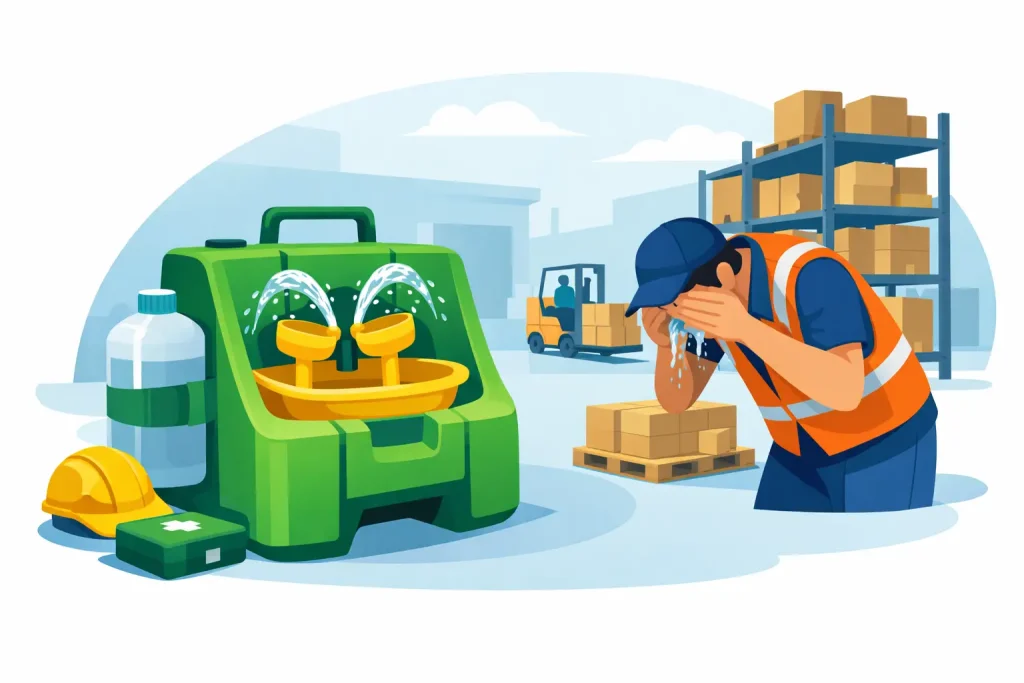
A forklift clips a drum, dust lifts into the air, and one worker gets a splash in the eyes. That is not the moment to realize the nearest plumbed eyewash point is two aisles away or blocked by pallets. A portable eyewash station for warehouse settings solves a simple but serious problem – getting immediate eye flushing to the injured worker without waiting for plumbing access or losing time moving across the facility.
Warehouses are not all the same. Some handle sealed cartons and dry goods. Others deal with batteries, cleaning chemicals, oils, solvents, adhesives, or maintenance fluids. Even in lower-risk sites, dust, particles, and accidental splashes still happen. That is why many warehouse managers and EHS teams treat portable eyewash units as a practical part of emergency response planning, especially in temporary work zones, loading areas, maintenance corners, and remote sections of a large building.
Why a portable eyewash station for warehouse areas makes sense
The biggest advantage is flexibility. A plumbed eyewash station is fixed in one location, which works well when hazards stay in one place. Warehouses rarely operate that neatly. Inventory shifts, racking layouts change, repacking stations move, and maintenance tasks happen where they are needed. A portable unit can be placed closer to the actual risk.
That matters because eye exposure needs immediate flushing. Every second counts when dust, chemical splashes, or airborne particles get into the eye. If a worker has to navigate around traffic lanes, doors, or stacked goods, response time slows down. Portable units reduce that gap.
Cost is another factor. Installing a plumbed eyewash point can involve pipework, drainage, labor, and downtime. For some facilities, especially leased warehouses or temporary operating spaces, that investment does not make sense. A portable station gives coverage without major installation work.
There is a trade-off, of course. Portable units need manual refilling, cleaning, and inspection. A plumbed unit may offer simpler long-term consistency in a fixed hazard zone. The right choice depends on warehouse layout, hazard level, and whether the risk area is permanent or mobile.
Where portable eyewash stations work best in a warehouse
Not every corner of a warehouse needs one. Placement should follow actual exposure risk, not guesswork.
Battery charging areas are one common example. If staff handle batteries, electrolyte exposure becomes a real concern. Maintenance bays are another, especially where lubricants, degreasers, coolants, or cleaning chemicals are used. Loading docks can also justify portable eyewash coverage when chemical products are received, transferred, or damaged in transit.
Some warehouses use portable eyewash units near spill response stations. This is a smart pairing when employees may respond to leaks, damaged containers, or cleanup tasks involving absorbents and neutralizing materials. In these cases, eyewash support is part of a wider hazard response setup, not a standalone purchase.
Large facilities also use them in remote aisles or mezzanine levels where travel distance to a fixed station is not ideal. If the site changes often, a portable unit gives operations teams more control over placement.
What to look for before you buy
Capacity comes first. A small unit may suit a low-frequency risk area or support temporary work. A larger-capacity unit is better when the warehouse handles chemical products more regularly or when a dedicated emergency station is required for a fixed section. Buyers should think beyond price and ask how long the unit can realistically support flushing and how often it will need service.
The activation method matters too. In an emergency, workers need something simple and obvious. Controls should be easy to operate with minimal effort. If a person is in pain or has limited visibility, a complicated setup creates delay.
Portability is another practical issue. Some units are wall-mounted but refillable, while others are fully mobile and can be moved to different work areas. A warehouse with changing layouts may benefit more from a truly portable design. On the other hand, if the hazard area is stable, a semi-fixed unit may give better visibility and accountability.
Material durability should not be overlooked. Warehouse equipment gets bumped. Stations near dock areas, battery zones, or maintenance spaces need housings that can handle tough surroundings. A flimsy unit may be cheaper upfront but less reliable over time.
Visibility is also part of performance. A portable eyewash station for warehouse operations should be clearly marked and easy to spot fast. If it blends into shelving or sits behind stored goods, the benefit is lost. Buyers should plan for signage and clear access at the same time as the unit itself.
Capacity, maintenance, and water quality
This is where many purchasing decisions go wrong. A portable eyewash station is not just a tank of water. It is emergency equipment, which means maintenance discipline matters.
Stored water has to remain suitable for emergency flushing. That means scheduled refilling, cleaning, and, where applicable, using preservative solutions or following the manufacturer’s servicing guidance. If the unit is left unchecked, it may not be ready when needed.
Procurement teams sometimes focus only on the initial product cost. Operations teams know the real cost includes routine checks and staff responsibility. Before buying, decide who will inspect it, how often, and what the documented process will be. A good unit with poor maintenance is still a poor safety outcome.
Capacity also links directly to site conditions. A warehouse with one maintenance technician doing occasional chemical handling does not need the same setup as a battery storage or chemical distribution facility. More risk usually means a larger or more dedicated solution. Less risk may justify a smaller, lower-cost option, as long as access remains practical and response is still fast.
Common buying mistakes
One common mistake is treating every warehouse the same. A dry-goods logistics center has different eye injury risks than a warehouse handling industrial cleaners or automotive fluids. Buyers should match the station to the hazard, not to a generic checklist.
Another mistake is placing the unit where there is free wall space instead of where the hazard exists. Eyewash equipment should support actual workflow and risk points. If the unit is technically on site but too far from the problem area, it does not solve much.
Some teams also forget environmental conditions. High heat, dusty conditions, outdoor-adjacent dock areas, and rough handling all affect equipment performance and upkeep. The warehouse environment should shape the specification.
The last major mistake is buying without considering the rest of the emergency response setup. Eyewash stations often make the most sense alongside spill kits, absorbents, emergency showers, and clear incident procedures. Safety equipment works better as a system.
Portable vs plumbed eyewash – which is better?
For many buyers, the answer is not either-or. It is both.
A plumbed station is usually better for permanent, high-risk process areas where hazards are constant and infrastructure is available. A portable station is better where risk points move, installation is impractical, or coverage needs to be added quickly. In some warehouses, the best setup is a fixed station in one main hazard area plus one or more portable units supporting remote work zones.
That mixed approach often gives stronger coverage without overbuilding the site. It also helps budget control. Instead of paying for multiple plumbing installations, the business can place portable units where flexibility matters most.
A practical buying approach for warehouse teams
Start with the hazard map. Identify where eye exposure could happen from chemicals, dust, particles, or fluid handling. Then check travel distance, access routes, and whether existing emergency equipment already covers those points.
Next, decide if the risk area is fixed or changeable. If layouts move, portable eyewash is usually the more practical answer. If hazards are permanent and high frequency, compare portable and plumbed options based on long-term maintenance and site infrastructure.
Then review service requirements before issuing a purchase order. Make sure the warehouse team can actually maintain the unit properly. Reliable supply, ready stock, and straightforward replacement support matter just as much as the product spec. For industrial buyers who want fast ordering and practical safety equipment, suppliers like FUMiKA are often chosen because availability and price matter when compliance gaps need to be closed quickly.
The right portable eyewash station is the one your team can reach fast, operate without confusion, and keep ready every day – because in a warehouse emergency, practical beats impressive every time.