
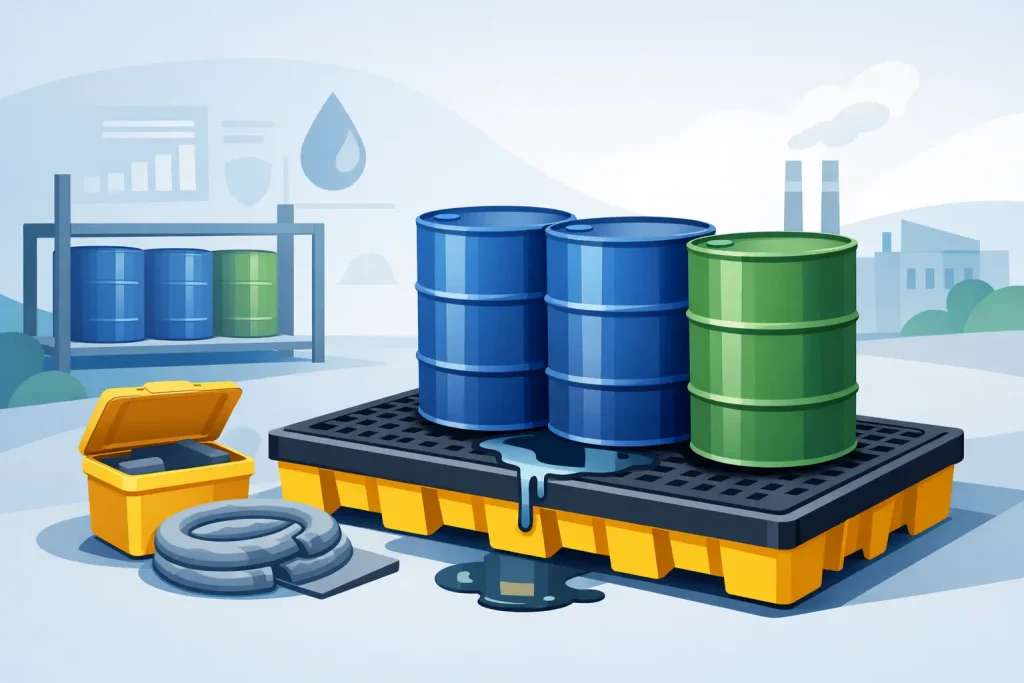
A leaking drum rarely stays a small problem for long. One damaged container can spread oil or chemicals across a warehouse floor, interrupt loading, create a slip hazard, and leave your team dealing with cleanup, reporting, and lost time. That is why choosing the right spill containment pallet for drums matters before a spill happens, not after.
For warehouse managers, EHS teams, and procurement buyers, the challenge is usually not whether secondary containment is needed. It is selecting the right unit for the actual job. Drum count, chemical compatibility, forklift access, sump capacity, and floor space all affect what works on site. Buy too small, and you create risk. Buy the wrong material, and the pallet may not hold up to the liquids you store.
What a spill containment pallet for drums does
A spill containment pallet for drums is designed to hold drums above a contained sump so leaks, drips, and full or partial releases do not spread onto the floor. In practical terms, it gives you a controlled storage point for hazardous or messy liquids while making drum handling more organized.
This matters in facilities that store oils, fuels, coolants, solvents, cleaning chemicals, paints, or process liquids. Even when drums are sealed and handled properly, valves fail, bungs loosen, and containers get damaged during movement. Secondary containment helps reduce immediate exposure, protects the floor and drains, and supports safer response if an incident occurs.
The right pallet also improves day-to-day housekeeping. Small drips collect in the sump instead of spreading under racks or machinery. That makes inspections easier and keeps storage zones cleaner.
How to choose a spill containment pallet for drums
The best choice depends on your storage pattern, the liquid involved, and how your operators move drums. A buyer looking at price alone can easily end up with the wrong unit.
Start with drum quantity and layout
First, decide how many drums need containment in one location. Common setups include single-drum units, two-drum pallets, and four-drum pallets. If drums are stored in several smaller points around a site, multiple compact units may work better than one large pallet. If inventory is centralized, a higher-capacity layout may be more efficient.
Think about access as well. If operators need to dispense from drums regularly, the pallet should allow stable placement and safe reach. If drums are mostly static storage, footprint and sump volume may matter more than dispensing convenience.
A common mistake is choosing based on current use only. If your site regularly scales inventory up during peak periods, buy for realistic operating conditions, not ideal ones.
Check sump capacity carefully
Sump capacity is one of the most important specifications. The pallet must be able to collect leaks or spills from the drums stored on it, in line with your site policy and applicable regulatory requirements. Buyers often focus on top deck size and overlook the actual containment volume underneath.
This is where cheap products can become expensive. A pallet may look suitable for four drums but offer limited sump capacity. If one drum fails, the containment may not be adequate for the risk level of your site.
For mixed facilities, it is smart to standardize around units with practical reserve capacity rather than selecting the bare minimum every time. That gives operations more flexibility.
Match pallet material to the liquid stored
Not all spill pallets handle all liquids equally well. Polyethylene models are widely used because they resist many chemicals and will not rust. They are often the safer all-around choice for corrosive liquids, chemical storage areas, and wet environments.
Steel units can make sense where heavy-duty loading, fire-related site rules, or specific operational demands favor a metal structure. But steel and aggressive chemicals are not always a good match. If the stored liquid can corrode the pallet, you are creating a new problem instead of solving one.
This is one of those decisions where it depends on the actual fluid. For oils and general industrial liquids, several options may be suitable. For acids, caustics, and harsher chemicals, compatibility should be checked before purchase.
Consider forklift and pallet jack handling
A containment pallet has to work with the way your team moves product. If operators reposition drums by forklift, make sure the unit supports forklift access where needed. If the pallet will remain fixed in a storage zone, mobility may be less important than stability.
Do not assume every model handles the same way. Some are easier to relocate when empty but not intended for movement under full load. Others are built for more active warehouse use. If your operation is fast-paced, handling design matters as much as containment.
Low-profile designs can also be useful where manual drum loading is common. They reduce lifting effort and can improve daily usability. The trade-off is that some low-profile models may differ in sump depth or structural layout, so compare the full specification, not just the loading height.
Where drum spill pallets are most useful
The most obvious application is chemical and oil storage, but the real use cases are broader. Manufacturing plants use them in raw material storage and maintenance areas. Logistics and transport sites use them for diesel, lubricants, and backup fluids. Workshops rely on them for waste oil and drum dispensing points.
Laboratories, healthcare maintenance teams, agriculture operations, marine environments, and public works sites also benefit from contained drum storage. Any location with liquid containers and a hard floor or nearby drain should take secondary containment seriously.
In many facilities, the best placement is not only in the main storage room. Satellite risk points matter too. A single drum near a generator, wash bay, or service area can create the same cleanup problem as a larger bulk storage zone if there is no containment underneath it.
Common buying mistakes
The first mistake is underestimating the spill risk because drums are “only temporary” in a location. Temporary drum storage often becomes permanent in real operations. If a drum sits there for days or weeks, it needs proper containment.
The second mistake is buying by dimensions alone. A pallet that fits the floor space but does not suit the chemical, load, or handling method is not a good buy.
The third mistake is ignoring cleanup planning. A spill containment pallet helps control a release, but you still need absorbent pads, socks, pillows, or the correct spill kit nearby. Containment and response should be planned together.
The fourth mistake is choosing the lowest-cost option without thinking about lifespan. In industrial use, a pallet takes abuse from drums, tools, loading equipment, weather, and chemical exposure. A cheaper unit that cracks, warps, or degrades early is not cost control.
How to get more value from the pallet you buy
Once installed, the pallet should be part of a simple spill control routine. Inspect the sump area, grating, and load condition regularly. Check that stored liquids still match the intended use. Keep the top surface clear of debris so leaks are visible.
It also helps to position the pallet where operators will actually use it. If the correct containment point is too far away, too cramped, or awkward to load, drums will end up on the floor instead. Practical placement improves compliance far more than signs on a wall.
For facilities with multiple hazard zones, standardizing pallet types can simplify training and purchasing. Procurement teams benefit from fewer part variations, and operators become more familiar with proper use.
If you are ordering for a growing site, choose a supplier that can support related spill control needs as well, from absorbents to spill kits and emergency response products. That makes replenishment faster and keeps purchasing more efficient. For buyers who need ready stock, straightforward pricing, and industrial-grade options, suppliers such as FUMiKA are often preferred because availability and speed matter just as much as specification.
Buying for compliance and daily operations
Compliance is part of the decision, but daily operations should guide the final choice. The right spill containment pallet for drums helps you meet storage standards while keeping the work area safer and easier to manage. It supports cleaner floors, faster inspections, and a more controlled response when something goes wrong.
That is the real value. You are not just buying a plastic or steel platform. You are reducing cleanup time, protecting people, limiting spread, and avoiding the kind of preventable incident that disrupts an entire shift. If your site stores drums, the better question is not whether you need containment. It is whether the pallet you choose will still make sense when the first leak actually happens.