
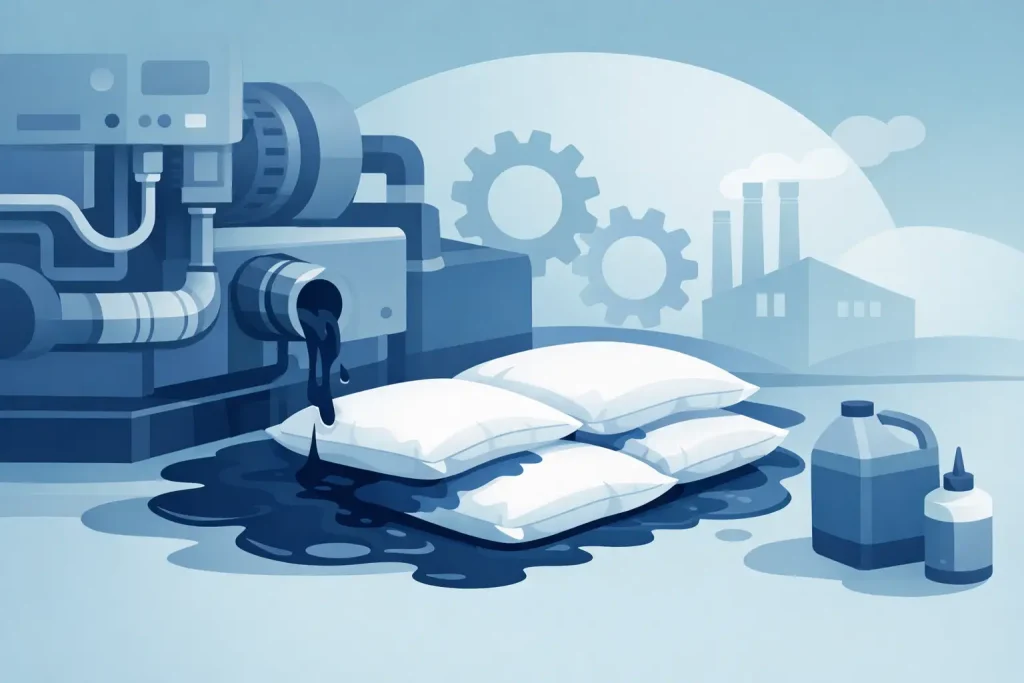
A leaking hydraulic line under a press, coolant dripping from a CNC machine, or oil collecting beneath a generator can turn into a safety problem faster than most teams expect. Absorbent pillows for machine leaks are built for exactly this kind of job – catching fluid where it pools, fitting into tight spaces, and helping contain small to moderate leaks before they spread across the floor.
For maintenance teams and EHS personnel, the real issue is not just cleanup. It is slip risk, equipment contamination, wasted product, and avoidable downtime. When a machine leaks repeatedly, you need an absorbent that can sit close to the source, hold a meaningful volume of liquid, and stay in place while the problem is being repaired. That is where pillows make more sense than standard pads alone.
Why absorbent pillows for machine leaks work
Pads are useful on open floor areas. Socks are useful when you need to block flow and form a perimeter. Pillows are different. They are designed to sit under dripping points, inside drip trays, beneath valves, around pumps, or in machine cavities where liquid gathers in one spot.
That shape matters. A pillow has more depth than a pad, so it can absorb and retain a larger amount of liquid in a compact footprint. In practical terms, that means fewer change-outs in areas where the leak is concentrated. In busy production areas, that saves labor and reduces disruption.
Another advantage is placement. Machine leaks do not always happen on a clean, flat floor. They happen behind guards, under pipe connections, beside reservoirs, and around base plates. Pillows are easier to position in these locations because they can be tucked into confined spaces without spreading out or lifting at the edges.
This does not mean pillows replace every other absorbent. If fluid is already moving across a walkway, a pillow on its own is not enough. You may need socks to contain the spill path and pads to cover the surrounding floor. The best spill response setup usually combines products based on how the leak behaves.
Where machine leak pillows are commonly used
Absorbent pillows for machine leaks are widely used anywhere fluid loss is part of normal wear, poor sealing, or temporary equipment failure. Manufacturing plants use them under hydraulic machinery, compressors, lathes, milling equipment, and conveyor drive systems. Workshops place them below vehicles, pumps, engine stands, and service bays. Warehouses and facility teams use them around backup generators, HVAC systems, and maintenance rooms.
They are also a practical fit for marine, transport, and oil handling environments where oil drips can collect in narrow spaces. In laboratories or chemical process areas, the correct chemical-grade pillow can help control leaks from containers, transfer points, and dosing equipment. The key point is absorbent compatibility. Not every pillow is suitable for every liquid.
If your site handles mixed fluids, product selection should be based on what is leaking most often. Oil-only absorbents are ideal when you need to target hydrocarbons and avoid taking in water. Universal absorbents are a better fit for mixed maintenance areas handling coolants, solvents, water-based fluids, and oils. Chemical absorbents are necessary when aggressive liquids are involved. Choosing the wrong type creates risk and increases waste cost.
How to choose the right absorbent pillow
Start with the liquid. This is the first filter and the most important one. Oil leaks from machinery, diesel drips, lubricants, and hydraulic fluids usually call for oil absorbents. General plant leaks such as water, coolant, light chemicals, and mixed shop fluids often suit universal absorbents. Corrosive or unknown chemical leaks need chemical-resistant absorbents and a more controlled response process.
Next, consider the leak pattern. A slow drip from a fitting is different from a steady seep under pressure. If the fluid collects in one point, a pillow is usually efficient. If it spreads before pooling, you may need a sock first and then place the pillow at the lowest collection area.
Size matters too. A pillow that is too small will saturate quickly and need constant replacement. One that is too large may not fit under the machine or inside the containment area. Buyers should measure the available space and estimate the likely fluid volume between inspections. In a low-access area, a higher-capacity pillow is often worth it because replacement takes time.
Material quality should not be overlooked. In industrial use, absorbents are handled, dragged, stepped near, and exposed to warm equipment surfaces. A low-grade outer layer can tear during use, releasing absorbed liquid or filler. For routine operations, it is worth buying pillows made for industrial handling rather than treating them as disposable afterthoughts.
Pillows vs pads vs socks
This comparison matters because buyers often try to solve every leak with one product. That usually leads to overspending or poor control.
Pads are the better choice when liquid is already spread over a floor surface or when operators need to wipe and cover a broad area quickly. They are easy to deploy and replace, but they are less efficient in deep pooling points.
Socks are designed for control rather than volume. They guide and contain the spill, especially around equipment bases or across doorways and walk paths. They are not usually the best primary absorbent for a drip point unless the leak is light.
Pillows are strongest when the leak is localized and ongoing. They absorb more in a smaller area and can stay under the source while maintenance is scheduled. If your site deals with repeated machine drips, pillows are often the most practical first-line absorbent, with pads and socks supporting the response around them.
Common buying mistakes
One common mistake is selecting by price alone. Low-cost absorbents can look similar in a product photo, but real performance shows up during saturation, retention, and handling. If the pillow fails early, replacement frequency goes up and the total cost rises with it.
Another mistake is ignoring disposal requirements. Once saturated, absorbents take on the waste category of the liquid absorbed. A pillow used for harmless water is one thing. A pillow soaked with oil, solvent, or chemical residue may require controlled disposal. Procurement and EHS teams should factor this into the buying decision.
The third mistake is understocking. Machine leaks rarely wait for a purchase cycle. Sites that carry only a small quantity of absorbents often end up using the wrong product because it is the only one available. A better approach is to keep pillows in the maintenance store, near high-risk machines, and inside spill kits where recurring leaks are known to happen.
Building a practical machine leak response setup
For most facilities, the best setup is simple. Keep absorbent pillows near equipment that drips or seeps regularly. Pair them with absorbent pads for surrounding floor cleanup and socks for quick perimeter control. Where larger spill risk exists, back this up with the correct spill kit size and, if needed, spill containment pallets for drums or liquid storage points.
This kind of layered approach is what reduces disruption. Operators can place a pillow immediately, isolate the area, and keep the leak from becoming a larger housekeeping or safety incident. Maintenance can then repair the machine without the floor condition getting worse every hour.
If you are buying for multiple departments, standardizing absorbent types can also help. Too many product variations create confusion during response. A practical range with clear use cases is easier to store, issue, and reorder. That is why many industrial buyers prefer working with a supplier that can provide pillows, pads, socks, kits, and containment products from one source. For operations that need fast access and straightforward product selection, FUMiKA is positioned around that exact requirement.
When absorbent pillows are not enough
There is a limit to what any absorbent can do. If a machine is leaking heavily, actively spraying fluid, or releasing hazardous chemicals, the absorbent is a temporary control measure, not the solution. The machine may need to be isolated, the area restricted, and the response handled under site spill procedures.
The same applies if the leak reaches drains, ignition sources, or shared work paths. In those cases, containment and escalation are more important than simply placing more absorbents. Buyers should think of pillows as part of spill readiness, not a substitute for maintenance discipline or proper risk control.
Good spill control is rarely complicated. It is usually about having the right absorbent in the right place before the leak turns into an incident, and pillows are one of the most effective tools for that job when machinery starts dripping where it should not.