
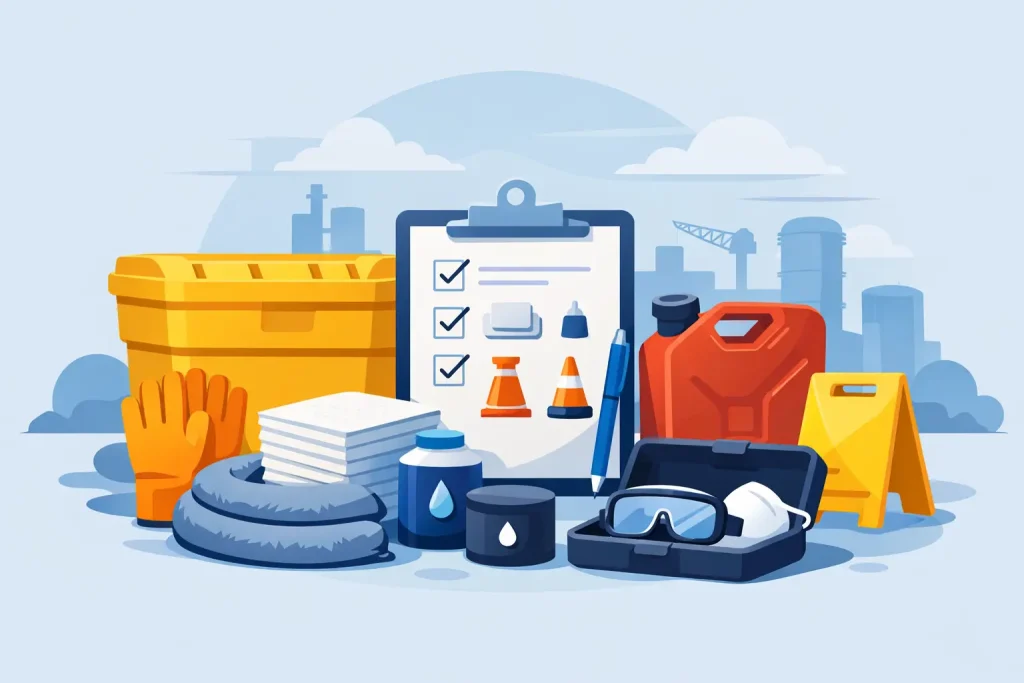
A spill kit that looks complete at a glance can still fail when the wrong absorbent, missing PPE, or undersized disposal bag slows response. That is why a proper spill kit contents checklist matters. For warehouses, workshops, labs, loading bays, and production floors, the right contents are not just about cleanup – they support faster control, safer handling, and better compliance when a leak or spill happens.
What a spill kit contents checklist should cover
A useful checklist does more than name a few pads and gloves. It should match the liquid type, the likely spill volume, and the environment where the kit will be stored. A small maintenance area handling hydraulic oil has different needs from a chemical dosing room or a transport yard.
At minimum, most spill kits should include absorbent pads, absorbent socks, disposal bags, protective gloves, and clear instructions for use. Many sites also need goggles, a dustpan, a brush, a drain cover, or absorbent pillows for larger leaks. The real question is not whether these items are helpful. It is whether they are enough for the spill risks on your site.
Core items on a spill kit contents checklist
Absorbent pads are usually the first item teams reach for because they work fast on surface spills and are easy to deploy. They are suitable for wiping, covering pooled liquids, and final cleanup after the spill has been contained. Pads are standard in most kits because they are versatile, but the absorbent type still matters. Oil-only pads are the right choice for hydrocarbons, while universal or chemical absorbents are better for mixed workplace risks.
Absorbent socks are just as important because they control spread before cleanup starts. They are placed around the spill, near leaking equipment, or across doorways and drains to contain flow. On smooth floors, socks often do more to limit damage than pads alone. If your site has frequent leaks from drums, machinery, or IBC handling, socks should never be treated as optional.
Absorbent pillows are commonly included in medium and large kits for heavier leakage points. They are useful under valves, pumps, machine bases, and damaged containers where liquid is collecting in one area. Not every site needs multiple pillows in every kit, but they make sense where spills tend to come from a single source rather than from a wide splash.
Personal protective equipment belongs on every spill kit contents checklist. At minimum, this usually means chemical-resistant gloves. Depending on the risk, you may also need goggles, aprons, sleeve protection, or masks. A spill kit without basic PPE creates a predictable problem – staff hesitate to respond, or they handle the spill with inadequate protection. That delay can turn a minor incident into a wider contamination issue.
Disposal bags and ties are essential because cleanup is only half the job. Used pads, socks, contaminated PPE, and loose debris need to be bagged quickly and isolated for disposal according to site procedures. If the kit has no proper waste bags, responders end up improvising with whatever is nearby, which is exactly what a prepared spill response setup is supposed to avoid.
Instruction sheets or response guides are often overlooked, especially on sites with experienced teams. But not every spill is handled by the most senior operator on shift. A simple instruction card inside the kit helps standardize response, especially in shared facilities, high-turnover environments, and contractor-heavy operations.
Matching the checklist to the spill type
This is where many buyers get caught out. A general spill kit contents checklist is useful, but a site-specific checklist is better.
For oil and fuel spills, the kit should contain oil-only absorbents that repel water and target hydrocarbons. These are common for workshops, transport fleets, marine areas, generator rooms, and maintenance departments. If the kit may be used outdoors, oil-only absorbents become even more practical because they can perform in wet conditions where water is present.
For chemical spills, the checklist needs to be stricter. Chemical absorbents are designed for aggressive liquids and hazardous substances, and the PPE requirement is usually higher. In labs, chemical stores, cleaning chemical rooms, plating operations, and process plants, this is not an area for substitutions. Using a universal pad on a high-risk chemical spill may be a poor decision if the absorbent is not rated for the substance involved.
For general workplace spills, universal spill kits are often the most cost-effective option. These can handle coolants, water-based fluids, solvents in some environments, and light oils across mixed-use industrial settings. They work well in warehouses, production floors, service areas, and facilities that do not store high-risk chemicals in volume.
Size matters as much as contents
A checklist is only useful if the quantities make sense. A 20L kit can be suitable for service vehicles, small workshops, and local response points near machines. A 60L kit fits many standard industrial areas where moderate leaks are possible. A 120L or 240L kit is usually better for bulk storage, loading zones, larger workshops, process plants, and sites with drums or intermediate bulk containers.
Too small, and the kit is exhausted before the spill is under control. Too large, and you may be paying for capacity that sits unused in a low-risk corner. The better approach is to match kit size to both spill volume and response distance. If teams need to run across the building to reach the only large kit, response time suffers. In many facilities, multiple smaller kits placed near risk points work better than one central unit.
A practical spill kit contents checklist by category
If you are reviewing current stock, check that each spill kit includes enough of the following categories for the risk level:
- Absorbent pads for fast surface pickup
- Absorbent socks for spill containment
- Absorbent pillows for concentrated leaks where needed
- Gloves and appropriate PPE
- Disposal bags and bag ties
- Instruction sheet or spill response guide
- Brush, scoop, or dustpan if loose cleanup is expected
- Drain cover or containment accessory where drains are nearby
That is the baseline. From there, adjust for chemical compatibility, spill volume, and operating environment.
Common checklist mistakes buyers should avoid
The first mistake is treating all spill kits as interchangeable. They are not. Oil, chemical, and universal kits serve different jobs, and using the wrong one can slow response or create handling risk.
The second mistake is focusing only on absorbents while ignoring PPE and disposal. A kit loaded with pads but missing gloves and waste bags is incomplete. Buyers sometimes prioritize visible cleanup items because they seem more important, but response safety is part of the equation.
The third mistake is underestimating the spill path. If your site has drains, ramps, outdoor runoff, or traffic lanes, containment accessories become much more important. A spill that reaches a drain or forklift route becomes a bigger operational issue than the original leak.
The fourth mistake is failing to restock after use. This sounds obvious, but partially used kits are common in busy facilities. A monthly check is usually enough for low-use areas, while high-risk zones may need more frequent inspection.
How to check whether your kit is actually ready
Start with the liquids on site. List what could spill, where it could happen, and the realistic volume. Then compare that against the absorbent type and quantity in each kit. If you store chemicals, do not assume a general kit is good enough. If you move oils or fuels outdoors, oil-only absorbents may be the better fit.
Next, look at placement. A well-stocked kit hidden in a far corner is less useful than a smaller kit placed next to the actual hazard. Good spill response depends on fast access.
Then check supporting equipment around the kit. In some areas, spill control works best as part of a broader setup that includes spill containment pallets, eyewash stations, or emergency showers. That depends on the hazard. A chemical handling area, for example, often needs more than absorbents alone.
For industrial buyers, the goal is simple: buy the right kit once, place it where spills are likely, and keep it ready. FUMiKA supplies spill control products in multiple sizes and types because a one-size-fits-all approach rarely works on real operating sites.
A good spill kit contents checklist does not need to be complicated. It just needs to be honest about your risks, practical about your response time, and complete enough to let your team act without hesitation when the floor is wet and the clock is already running.