
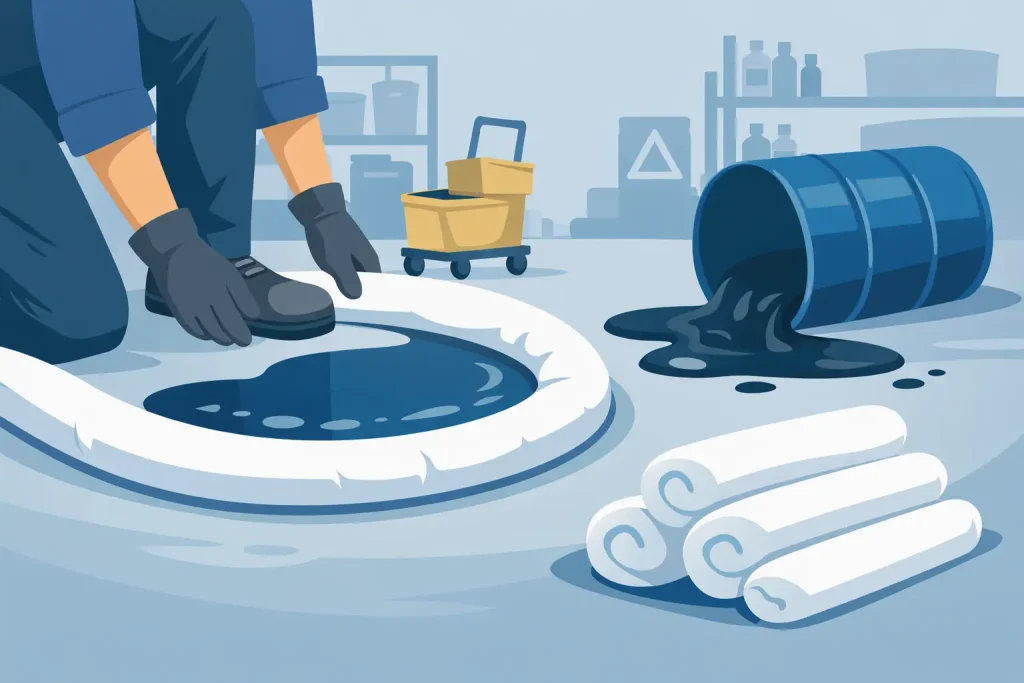
A leaking drum rarely gives you much warning. One minute the floor is clear, and the next minute liquid is moving toward a walkway, machine base, or drain. That is exactly when to use absorbent socks – when you need to stop a spill from spreading before cleanup turns into a larger safety and compliance problem.
Absorbent socks are one of the most practical spill-control tools for industrial sites because they do two jobs at once. They create a barrier around the spill, and they start absorbing the liquid immediately. For warehouses, workshops, loading bays, plants, labs, and maintenance areas, that makes them a fast first-response product rather than an optional extra.
When to use absorbent socks at Work
The best time to use absorbent socks is at the containment stage of spill response. If liquid is already on the floor and moving outward, socks help you form a quick perimeter. Instead of chasing the spill with pads alone, you stop the spread first, then absorb the pooled liquid inside the contained area.
This is especially useful when the spill is heading toward sensitive zones such as floor drains, pedestrian paths, storage aisles, doorways, or equipment foundations. In these situations, speed matters more than perfection. A sock can be dropped and positioned in seconds, which helps reduce slip hazards and limits how far the liquid travels.
They are also useful for leaks that are not yet full spills. If a machine is dripping hydraulic oil, a container has a slow chemical leak, or a transfer point is weeping fluid during routine operations, placing an absorbent sock around the source can control the issue while the team arranges repair or safe transfer.
Where absorbent socks work best
Absorbent socks are most effective on flat surfaces where liquids tend to travel across the floor. That includes factory floors, concrete workshops, warehouse lanes, production areas, maintenance bays, and utility rooms. Because socks are flexible, they can be curved around machinery, wrapped around drums, or placed along edges where straight barriers do not fit well.
They are particularly useful around drains. If there is any chance a spill could enter a drainage system, using socks early gives your response team a chance to isolate the area before contamination spreads beyond the immediate work zone. In many facilities, this is one of the most important reasons to keep socks inside a spill kit.
Outdoor use also makes sense, but with a caution. If you are dealing with uneven ground, rainwater flow, or strong wind, a sock still helps with first containment, but you may need additional support such as pads, drain covers, or larger spill-control equipment. On rough surfaces, liquid can bypass weak contact points, so placement needs more care.
Absorbent socks vs pads and pillows
A common mistake is reaching for absorbent pads first in every spill situation. Pads are excellent for wiping up surface liquid, but they are not designed to create a perimeter. If the spill is spreading outward, the pad often becomes a cleanup tool after the liquid has already moved too far.
That is where absorbent socks have the advantage. They are designed to contain and channel the spill. Once the spill is boxed in, pads can be used inside the area to soak up the remaining liquid. Pillows, on the other hand, are better for larger pooled volumes or persistent leaks under equipment. Each absorbent product has a role, and socks are usually the first choice when movement and spread are the main problem.
In practical terms, think of socks as your first line, pads as your surface cleanup, and pillows as your high-volume absorbent. Sites that stock all three usually respond faster and with less waste.
Choosing the right sock for the liquid
Not every absorbent sock is suitable for every spill. The right choice depends on what liquid you are handling.
For oil and hydrocarbon spills, oil-only absorbent socks are the better option, especially in areas where water may also be present. These are common in workshops, marine operations, transport yards, generator rooms, and equipment servicing areas. They target oils and fuels without taking in water, which helps preserve absorbent capacity.
For chemical spills, use chemical absorbent socks that are compatible with aggressive or unknown liquids. Laboratories, production plants, battery areas, and chemical storage zones should not rely on general-purpose absorbents alone if corrosive or hazardous materials are involved.
For mixed-use industrial environments where water-based liquids, coolants, mild chemicals, and general fluids are common, universal absorbent socks are often the practical choice. They give broad coverage and simplify stockholding for facilities with varied spill risks.
The trade-off is simple. A universal sock is convenient, but a specialized sock can perform better in the right application. If your site handles a known spill profile, matching the absorbent type to that risk usually gives better control and lower replacement cost.
Signs your site should stock more absorbent socks
If your team regularly deals with drum handling, liquid transfer, machine maintenance, forklift battery servicing, vehicle leaks, or chemical decanting, you likely need absorbent socks within easy reach. The same applies if your facility has floor drains near fluid-handling areas, or if pedestrian traffic passes close to process equipment.
Another sign is when minor spills are taking too long to control. If staff are using rags, cardboard, or too many pads just to stop liquid from spreading, the response setup is incomplete. Absorbent socks reduce response time because they are purpose-built for containment.
Facilities with multiple risk zones should avoid storing all spill-control products in one remote location. A central spill kit is useful, but local access matters. Small response points near loading bays, chemical stores, workshops, and production lines can prevent a minor leak from becoming a shutdown event.
How to use absorbent socks effectively
Start by protecting the spill path, not just the center of the spill. Place the sock on the outer edge where liquid is moving, then build a perimeter around the source if it is safe to approach. If the spill is near a drain, isolate the drain side first.
Avoid leaving gaps between socks. If more than one sock is needed, overlap the ends slightly so liquid does not escape through the join. On larger spills, use socks to divide and control the area before bringing in pads or pillows for full absorption.
Do not treat socks as permanent leak management. They are a response product, not a substitute for maintenance or proper containment. If a leak continues, the source still needs to be isolated, repaired, or transferred safely.
Disposal matters too. Once saturated, absorbent socks should be handled according to the type of liquid absorbed and your site’s waste procedures. Oil, solvents, and chemicals may require different disposal controls. Fast response is important, but safe disposal is part of the job.
Common mistakes to avoid
One mistake is using the wrong absorbent type for the liquid. Another is waiting until the spill has spread too far before deploying containment. There is also the issue of understocking. A site with one small spill kit and several liquid-handling zones is often not prepared for real response conditions.
Teams also sometimes place socks only around the source and ignore where the liquid is heading. That works for a static puddle, but not for a moving spill on a sloped or busy floor. Always think about flow direction, drain entry points, and exposure to traffic.
Training should stay simple. Staff do not need a long theory session. They need to know which sock type to use, where it is stored, and how to contain first and clean second.
Why absorbent socks belong in every spill response setup
Absorbent socks are not complicated, and that is exactly why they work. They give industrial sites a fast, low-cost way to contain spills before injuries, contamination, or downtime escalate. For procurement teams and EHS managers, they are a practical product that supports both everyday housekeeping and emergency response readiness.
If your site handles oils, chemicals, coolants, washdown fluids, or leaking equipment, absorbent socks should not be an afterthought inside the storeroom. They should be part of the front-line response setup, ready to deploy where spills are most likely to happen. FUMiKA supplies absorbent socks and spill-control products for workplaces that need reliable stock, fast ordering, and practical protection without delay.
A good spill response plan does not start when the floor is already covered – it starts with having the right containment product within reach.