
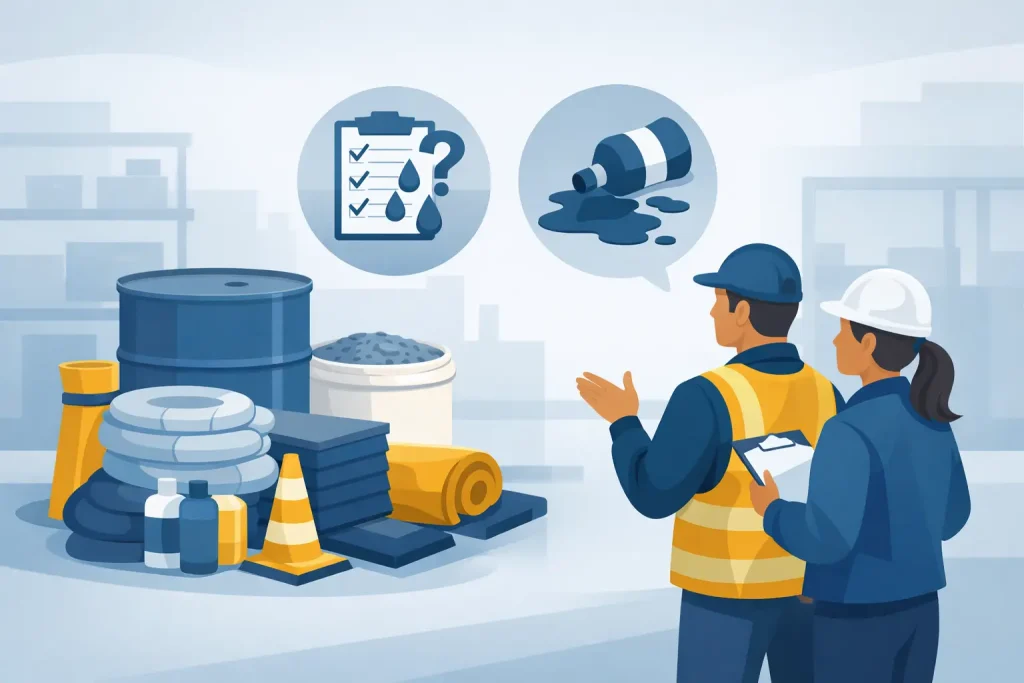
A spill rarely gives you time to think. One leaking drum, an overturned container, or a forklift clipping a fluid line can stop operations fast, create slip hazards, damage stock, and put your team at risk. That is why workplace spill response equipment needs to be selected before the incident happens, not after someone starts searching for absorbents during an emergency.
For most industrial sites, the real issue is not whether spill equipment is needed. The real issue is whether the equipment on hand actually matches the liquids used, the spill volume likely to occur, and the speed required to control the hazard. A small workshop, warehouse, lab, production line, or loading bay may all need spill response products, but they do not need the exact same setup.
What workplace spill response equipment should include
In practical terms, workplace spill response equipment is the group of products used to contain, absorb, isolate, and support cleanup of leaked liquids. On many sites, this starts with a spill kit. But a proper response setup often goes beyond one bag or bin of absorbents.
A basic spill-ready workplace usually needs absorbent pads for quick surface pickup, absorbent socks to stop spread, and absorbent pillows for heavier pooling. It may also need containment pallets for drums and containers, plus emergency showers or eyewash stations where chemical exposure is possible. The right setup depends on the liquids present and the way the site operates.
If your team handles fuel, lubricants, coolants, solvents, acids, cleaning chemicals, or process liquids, then your equipment should be chosen around those risks. General-purpose products may be suitable in one area, while oil-only or chemical-specific kits are necessary in another. Buying one standard kit for the whole facility can look cost-effective at first, but it often creates gaps where response matters most.
Start with the spill risks on your site
The fastest way to choose the right equipment is to assess where spills are most likely and what those spills involve. A warehouse storing drums has one type of risk. A maintenance workshop has another. A laboratory, healthcare facility, marine site, or manufacturing line can have very different exposure concerns.
Think about the liquid first. Oil and hydrocarbon spills need materials designed to absorb oil effectively, especially around outdoor work zones or water-sensitive areas. Aggressive chemicals need chemical spill kits and decontamination support. Water-based liquids and non-hazardous fluids may be managed with general absorbents, but even then, spread control still matters because slip-and-fall incidents happen quickly.
Then look at volume. If the most likely event is a small leak from a machine, a compact 20L spill kit may be enough nearby. If you store larger drums, intermediate bulk containers, or multiple chemical containers in one area, larger capacities such as 60L, 120L, or 240L make more sense. The right size is not just about absorption capacity. It is also about making sure the response team does not run out of material halfway through containment.
Spill kits are the front line, but sizing matters
A lot of buyers focus on buying a spill kit because it is the most visible part of the response plan. That is sensible, but the details matter. A kit that is too small gets used up too fast. A kit that is too far from the hazard area might as well not be there.
Smaller kits work well for mobile teams, service vehicles, workshops, and isolated risk points. Medium kits suit warehouse aisles, loading areas, maintenance rooms, and production zones where moderate leaks are possible. Larger kits are better for sites storing bulk liquids, operating forklifts around fluid-handling zones, or managing outdoor transfer points.
Placement is just as important as capacity. If a spill can happen at the receiving bay, chemical store, maintenance station, and waste holding area, then one central kit may not be enough. Distributed coverage usually gives a faster and safer result than relying on a single oversized unit.
Choosing the right absorbents for the job
Absorbents are not interchangeable just because they look similar. Pads, socks, and pillows each solve a different problem. Pads are useful for fast wipe-up and surface recovery. Socks are used to contain spread around the spill perimeter, drains, equipment bases, or walkways. Pillows help when liquid has pooled and high absorbency is needed in one spot.
Material type also matters. Oil absorbents are the right choice for hydrocarbon spills and can be useful where water rejection is important. Chemical absorbents are designed for more aggressive substances. General-purpose absorbents can be practical for mixed industrial environments handling water-based fluids, coolants, and non-aggressive liquids.
Trying to save money by standardizing one absorbent type across every area can work in some facilities, but not in all. If the site handles both oils and corrosive chemicals, separate response products are usually the safer decision. The cost of incorrect response is always higher than the price difference between the right and wrong absorbent.
Containment pallets reduce the chance of a spill getting bigger
Response equipment deals with spills after they happen. Containment equipment helps stop a small leak from becoming a major cleanup issue. Spill containment pallets are especially useful under drums, pails, and chemical containers stored indoors or outdoors.
For procurement and operations teams, this is where compliance and practicality meet. A pallet gives secondary containment, reduces floor contamination risk, and helps keep storage areas organized. It also makes inspections easier because leaks are more visible and isolated. On sites with regular drum handling, containment pallets are one of the most cost-effective controls you can add.
There is a clear trade-off, though. Not every storage point needs the same pallet setup. A low-volume area may only need selective containment under the highest-risk containers, while a chemical storage room or waste staging zone may need broader coverage. The right decision depends on how many containers are stored, how often they are moved, and what would happen if one failed.
Do not overlook emergency eyewash and showers
When chemical splash risk exists, workplace spill response equipment should not be limited to absorbents and containment alone. Emergency eyewash stations and safety showers are part of practical incident response because they protect the worker while the spill is being controlled.
This is especially relevant in laboratories, chemical handling areas, maintenance workshops, battery charging zones, cleaning chemical storage, and production lines using corrosive or irritating liquids. If exposure can happen within seconds, decontamination equipment must be immediately accessible. Distance, water flow, visibility, and routine inspection all matter.
Many sites treat eyewash and shower stations as separate safety purchases. In reality, they should be considered part of the same response plan. A facility that can absorb a spill but cannot quickly flush chemical exposure still has a serious gap.
How to buy for speed, budget, and real use
Industrial buyers usually have three concerns: getting the right equipment, staying within budget, and getting stock quickly. Those are valid concerns, and they do not always point to the same product choice.
If budget is tight, start with the highest-risk areas first. Put the right spill kit capacity at likely spill points, add targeted absorbents for the liquids handled there, and protect bulk storage with containment pallets where leakage risk is highest. That gives you a practical base instead of spreading the budget too thin across low-priority areas.
If uptime is the main concern, availability becomes critical. Standardized products that can be reordered fast are often better than unusual configurations that look good on paper but are hard to replace. Sites with recurring maintenance activity or routine fluid transfer usually benefit from keeping extra pads, socks, and pillows in stock, not just one sealed kit.
For multi-area facilities, a mixed approach is often best. Use compact kits in mobile or smaller work zones, larger spill kits in storage or transfer areas, and add eyewash, showers, or containment where the hazard profile justifies it. That is usually more practical than trying to solve every problem with one product type.
Workplace spill response equipment works only if people can use it fast
Even the best equipment loses value if it is blocked, poorly labeled, or unfamiliar to staff. Storage should be visible and close to the hazard. Teams should know what each kit is for, who responds first, and when escalation is required.
That does not mean every site needs a complicated response program. It means the equipment needs to be easy to identify and suitable for the people expected to use it. Clear product selection helps a lot here. If the kit is matched to the actual hazard, response becomes faster and mistakes are less likely.
For buyers who want a practical, low-delay setup, FUMiKA focuses on ready-to-order spill control and workplace safety products that fit real industrial use. The goal is simple: get the right equipment on site before the next leak becomes a shutdown, injury, or compliance problem.
A good spill response setup is not about buying the most equipment. It is about putting the right equipment where the risk is real, so your team can act immediately when seconds matter.