
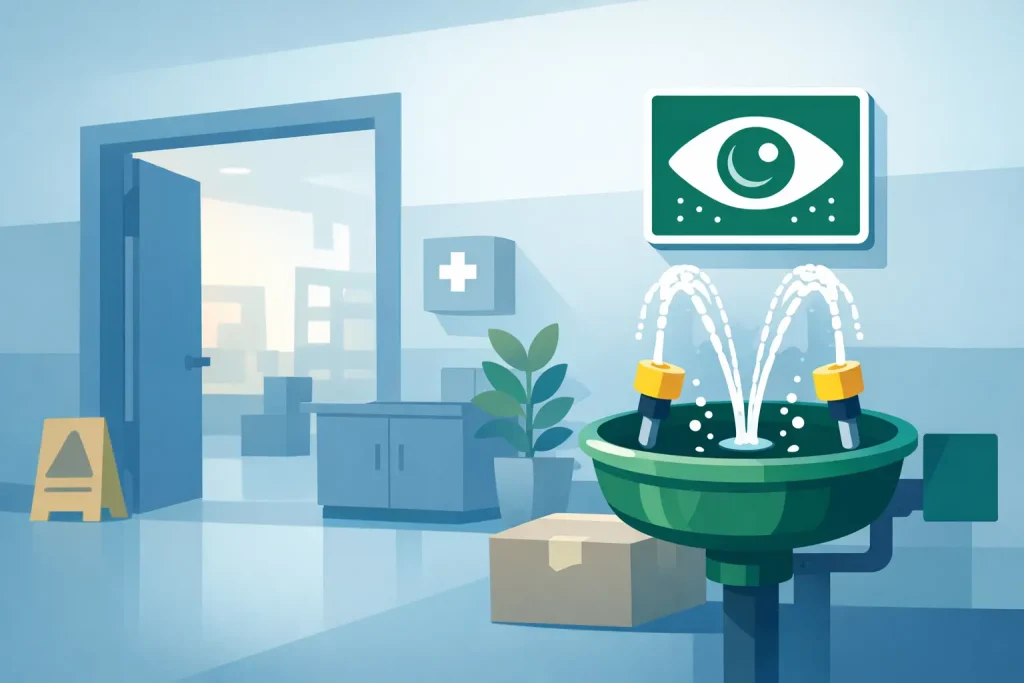
A worker does not get extra time to search for an eyewash station after a chemical splash. The right answer to where to place eyewash stations is simple in principle but critical in practice: put them as close as possible to the hazard, on the same level, with a clear path, and where they can be reached fast without opening barriers or weaving around equipment.
That sounds straightforward until you look at a real facility. Warehouses change layout. Production lines expand. Chemical storage moves. Temporary wash areas become permanent risk points. That is why eyewash placement should be based on actual exposure risk, not just empty wall space or whatever corner happens to be convenient for installation.
Where to place eyewash stations based on risk
Start with the hazard, not the product. Eyewash stations belong near any operation where eyes may be exposed to corrosives, irritants, solvents, cleaning chemicals, oils, dust, or airborne particles. In many facilities, that includes battery charging areas, chemical mixing zones, drum filling points, maintenance workshops, labs, paint areas, washdown stations, and fluid transfer locations.
The main goal is immediate access. If a worker gets a splash of acid, caustic cleaner, or solvent in the eyes, every second matters. Placement should support a quick response without requiring the worker to think, ask for help, or move through a congested route. In practical terms, that means the station should be very close to the hazard area and easy to identify at a glance.
If multiple hazards exist in one department, one centrally mounted unit may not be enough. A large production floor with several chemical handling points may require more than one station. The better question is not whether the site has an eyewash station, but whether every exposed worker can reach one fast from their actual work position.
Distance and access matter more than convenience
A common mistake is placing eyewash stations where plumbing is easiest or where the station looks tidy and out of the way. That may help installation, but it does not help an injured worker. The best location is the one that supports immediate use during a real emergency.
In most industrial settings, workers should be able to reach the unit within about 10 seconds. The path should be direct and unobstructed. No stacked pallets. No parked hand trucks. No drums, hoses, or swing doors in the way. If a station is technically installed in the department but blocked by daily operations, it is not properly placed.
The station should also be on the same level as the hazard. Stairs are a problem because a worker with impaired vision, pain, or panic may not be able to use them safely. Elevation changes, ramps with stored materials, and narrow aisle turns all increase response time. If the hazard is on the mezzanine, the eyewash should be on the mezzanine. If the chemical handling is inside a process room, the eyewash should be inside or immediately adjacent with no delay.
Keep the route clear at all times
This point gets ignored because layouts look good during inspections and fail during production. A proper location today can become a bad location next month after inventory shifts or equipment moves. Mark the area clearly and protect the access zone from storage creep.
Facilities with active forklift traffic should be especially careful. It is not enough to mount the station on a wall if that wall is regularly blocked by inbound materials or temporary staging. Eyewash access should be treated like fire equipment access – visible, protected, and non-negotiable.
Best places for eyewash stations in common work areas
In chemical storage and transfer areas, place eyewash stations near drum dispensing, decanting, and mixing points. These are the locations where splashes most often happen. If workers handle acids, alkalis, or concentrated cleaners, the station should be immediately available without crossing the room.
In laboratories, place units near benches or sink areas where chemicals are handled, but not so close that the station itself gets contaminated by the ongoing process. A worker should be able to move straight to it without dodging stools, carts, or open cabinet doors.
In maintenance shops, install eyewash stations near parts washing, lubricant handling, battery service, and chemical cleaning tasks. Grinding and dust-producing work can also justify placement, especially where particles may enter the eyes.
In warehouses and logistics environments, think beyond obvious chemical rooms. Battery charging stations, janitorial chemical closets, repacking zones, and vehicle maintenance corners often carry eye exposure risk. If those hazards are spread out, distributed coverage is better than one distant station near the office wall.
In manufacturing plants, placement often needs to follow the process flow. If chemicals are introduced at one part of the line and wash chemicals are used at another, each exposure point may need separate coverage. Large facilities should map actual handling steps rather than assuming one station per department is enough.
Indoor placement conditions that affect performance
A station can be close to the hazard and still be poorly located if the surrounding conditions make it difficult to use. Temperature is one example. Water that is too hot or too cold can discourage proper flushing. In some facilities, this means choosing a location that supports a tempered water supply or selecting equipment that fits site conditions.
Lighting also matters. In an emergency, workers need to spot the station immediately. Poorly lit corners, shadowed storage rooms, and low-visibility service corridors are weak choices even if they are technically nearby. The station should stand out with clear marking and enough surrounding visibility for fast access.
Contamination control matters too. Avoid placing eyewash stations where overspray, dust buildup, grease, or debris may affect operation. A station in a dirty maintenance corner may sit unused until the day it is needed, then fail expectations because no one kept the area clean.
Do not place them behind barriers
Avoid break rooms, offices, locked utility spaces, or enclosed cabinets that slow access. Eyewash stations are emergency equipment, not inventory items. Workers should not need a key, supervisor approval, or a complicated route to use one.
The same applies to doors. If a worker must open a heavy door or navigate a narrow entry while vision is impaired, placement is weak. The shortest practical route with the fewest obstacles is the right standard.
When you need both an eyewash and an emergency shower
Some hazards require more than eye flushing. If workers handle chemicals that can splash onto the face or body, a combination unit with emergency shower and eyewash may be the better setup. This is common in chemical processing, washdown operations, corrosive storage, and industrial cleaning areas.
Placement still follows the same rule: close to the hazard, fast to reach, and easy to operate. The difference is space planning. Combination units need enough surrounding clearance for full use, drainage consideration, and a location where workers can stand safely while flushing. Trying to squeeze one into a cramped corner usually creates problems later.
For buyers planning a new area or upgrading compliance, it makes sense to review eyewash placement together with spill kits, absorbents, and decontamination equipment. Hazard response works better when the site is planned as a system rather than a collection of separate products.
How to check if your current placement is good enough
Walk the route from each hazard point with the eyes of an injured worker, not a safety auditor with a clipboard. Can someone reach the station quickly with limited vision? Is the path always clear during busy shifts? Is the station visible, accessible, and close enough to the actual task?
Then check whether the facility has changed since the station was installed. New racking, temporary partitions, extra pallets, added machinery, or moved chemical inventory can all turn acceptable placement into poor placement. This is one reason practical site reviews matter more than one-time installation decisions.
For industrial sites buying replacement units or adding coverage, the most cost-effective approach is usually not the cheapest single unit. It is the setup that puts the right equipment where the risk actually exists. FUMiKA supplies eyewash stations and emergency response equipment for workplaces that need fast ordering, practical coverage, and ready-to-deploy safety solutions.
Good eyewash placement is not about filling a wall. It is about making sure the station is exactly where a worker needs it on the worst day, not somewhere nearby on paper.