
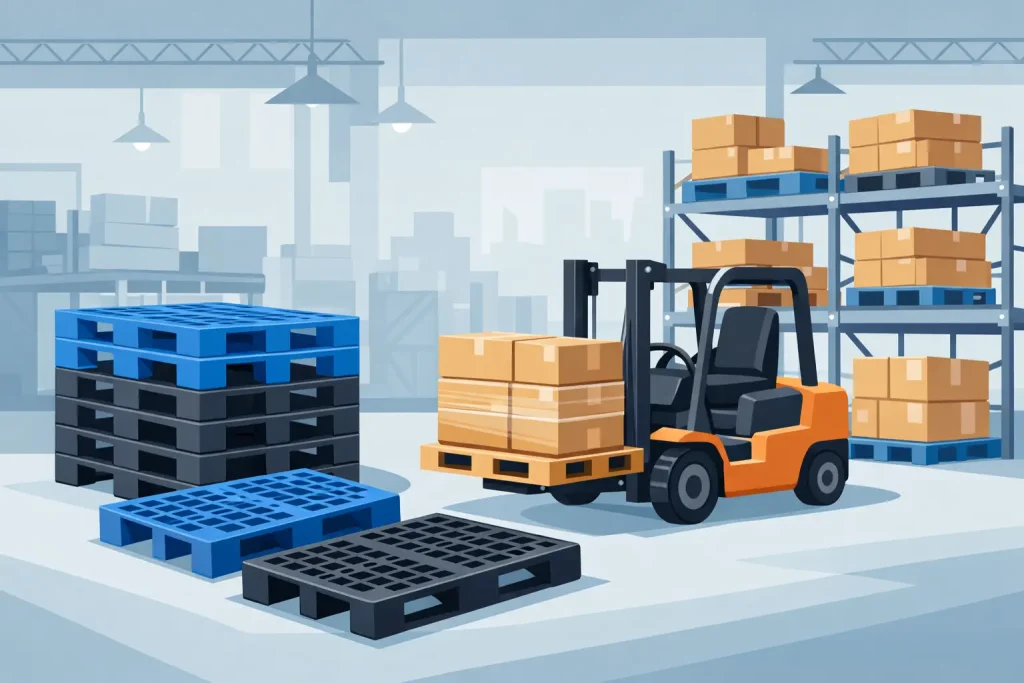
A warehouse pallet that fails under load does not stay a pallet problem for long. It becomes damaged stock, blocked aisles, forklift delays, and sometimes a safety incident. That is why many buyers looking at used plastic pallets for warehouse operations are not just chasing lower pricing. They are trying to control cost without creating a new risk on the floor.
Used plastic pallets can be a smart buy when the application is clear and the condition is properly checked. For many warehouses, they offer a practical middle ground between brand-new pallets and lower-grade alternatives that do not hold up in daily handling. The key is knowing where second-hand pallets make sense, where they do not, and what to inspect before placing a bulk order.
Why used plastic pallets for warehouse operations get attention
Most purchasing decisions in warehousing come down to throughput, damage rates, and replacement cost. New pallets can make sense for export programs, clean-room environments, or highly standardized automated systems. But in general storage, internal transfers, staging, and many racking applications, used plastic pallets can reduce upfront spending while still giving better consistency than many worn wood pallets.
Plastic pallets are valued because they do not absorb moisture, they are easier to wash down, and they do not produce nails, splinters, or loose boards. Even when bought second-hand, these advantages still matter. In food-adjacent operations, manufacturing, pharmaceuticals, chemical storage, and distribution centers, cleanliness and repeatable dimensions are often part of the reason plastic is preferred.
There is also a labor angle. When pallets are more uniform, forklift handling tends to be more predictable. That matters in fast-moving facilities where operators are picking, staging, and loading continuously. A low purchase price means very little if the pallet shape is inconsistent and slows down movement.
The real cost advantage
Used plastic pallets are usually considered for one reason first – price. That makes sense, but price only helps if the pallet stays in service long enough to justify the purchase.
A decent second-hand plastic pallet can deliver good value when it is used for repetitive internal movement, floor stacking, or lighter racking duty. Compared with new units, the savings can be meaningful, especially for buyers ordering in volume across multiple warehouse zones.
But this is where buyers need to stay practical. If the pallet has unknown impact history, repaired stress points, or too much wear, the lower price can disappear through product damage and replacement cycles. A warehouse manager should think in terms of cost per usable month, not just unit cost.
That is also why sourcing matters. A direct industrial supplier that can describe pallet type, dimensions, condition, and stock availability is usually a better route than buying mixed lots with little detail. If the load requirement is serious, vague product information is not a bargain.
Where used plastic pallets work best
Used plastic pallets are not automatically the right fit for every facility, but they work well in a lot of common warehouse setups.
They are often a strong option for closed-loop operations where pallets remain inside one site or move between controlled company locations. In this environment, the pallets are less likely to disappear, and wear can be monitored more easily. They also suit bulk storage areas where hygiene matters but a brand-new pallet is not necessary.
Many operations use them for raw material storage, finished goods staging, internal transfers, or spill-control support areas. In facilities that already use plastic containment products, including spill containment pallets, second-hand plastic pallets can also fit well into the broader site standard because they are easier to clean after dusty or wet conditions.
The fit becomes less straightforward when pallets are used in high-bay racking with heavy loads, export shipments with strict documentation requirements, or automated handling systems that depend on exact pallet geometry. In those cases, a used pallet may still work, but only if the model and condition match the technical requirement very closely.
How to inspect used plastic pallets for warehouse use
Condition is everything. A used plastic pallet should be treated like a load-bearing asset, not a disposable accessory. Before buying, check the deck, runners, feet, and entry points for cracks, deep gouges, missing sections, heat distortion, or repairs that suggest impact damage.
Pay close attention to the underside. Damage there is easy to miss and often becomes a handling issue later, especially in racking or repeated forklift entry. If a pallet flexes too much, rocks on the floor, or shows stress whitening around high-load points, that is a sign the material has been pushed hard.
It is also worth asking what the pallet was previously used for. If the prior environment involved chemicals, oils, or contamination risk, that history matters. Plastic is easier to clean than wood, but not every used pallet should be returned to every type of operation. For clean storage environments, prior use should be considered carefully.
Consistency across the batch matters too. A warehouse does not run efficiently on mixed dimensions and random pallet designs. Even if every pallet is technically usable, variation can create loading gaps, unstable stacks, and avoidable handling mistakes.
Load rating is not optional
A common mistake is assuming a plastic pallet is strong because it looks solid. Load performance depends on design, resin type, reinforcement, and how the pallet is used. Static load, dynamic load, and racking load are different things.
A pallet may perform well when sitting on the floor with a stable load, then fail when lifted or placed in selective racking. That is why buyers should match the pallet to the actual handling condition. If goods are moved by pallet jack, forklift, and rack beam, every one of those conditions should be considered before purchase.
This is especially important in warehouses carrying drums, pails, chemicals, machine parts, bagged raw material, or dense carton loads. Heavy inventory puts stress on plastic differently than light consumer goods. If the application is demanding, ask for clear load information and buy accordingly.
Hygiene, spills, and operational fit
Plastic pallets are often chosen because they support cleaner operations. They do not trap moisture the way wood can, and they are easier to wipe down or wash after contact with dust, grease, or minor leaks. For facilities with spill-response plans, this can be useful in staging areas where contamination control matters.
That does not mean a pallet replaces proper spill containment. If your warehouse stores chemicals, oils, or liquid raw materials, the right setup may include both plastic pallets and dedicated containment equipment. A pallet supports the load. A containment pallet manages leakage risk. The two serve different purposes, and mixing them up creates a compliance problem.
This is where a practical supplier matters. Buyers often need more than one item at the same time – pallets for storage, spill kits for quick response, absorbents for cleanup, and eyewash equipment where exposure risk exists. Purchasing by application instead of by single item usually leads to a better site setup.
When used plastic pallets are the wrong choice
There are cases where second-hand pallets are simply not worth the compromise. If a warehouse runs automation that depends on tight tolerances, new pallets are often the safer move. The same goes for very high-value goods where one pallet failure can cost far more than the initial savings.
Operations with strict customer specifications may also need new pallets, approved models, or documented material traceability. Used units can be harder to standardize at that level. And if the available stock is inconsistent, waiting for the right batch is better than forcing a poor fit into the operation.
Buyers should also be realistic about appearance. Used plastic pallets can show scuffs, discoloration, and normal wear even when structurally sound. If presentation matters for customer-facing shipments, that may influence the decision.
Buying smarter, not just cheaper
The best buying approach is simple. Start with the use case, not the price. Confirm pallet size, entry design, load requirement, and whether the pallet will be floor stacked, moved dynamically, or racked. Then look at condition and batch consistency.
For bulk buyers, it also helps to think about replenishment. If you need the same pallet type again in three months, can the supplier support that? Standardization makes warehouse management easier, especially across multiple sites.
A company like FUMiKA fits this kind of purchase when the priority is practical supply – ready stock, industrial-use products, and pricing that works for operations teams under pressure to buy fast and stay within budget. That matters when pallets are only one part of a broader warehouse safety and handling requirement.
Used plastic pallets are not the answer to every warehouse problem. But when the condition is verified and the application is right, they can be a solid, cost-controlled choice that supports cleaner handling and more predictable day-to-day movement. Buy with the real load in mind, and the pallet will do its job quietly, which is exactly what a warehouse needs.