
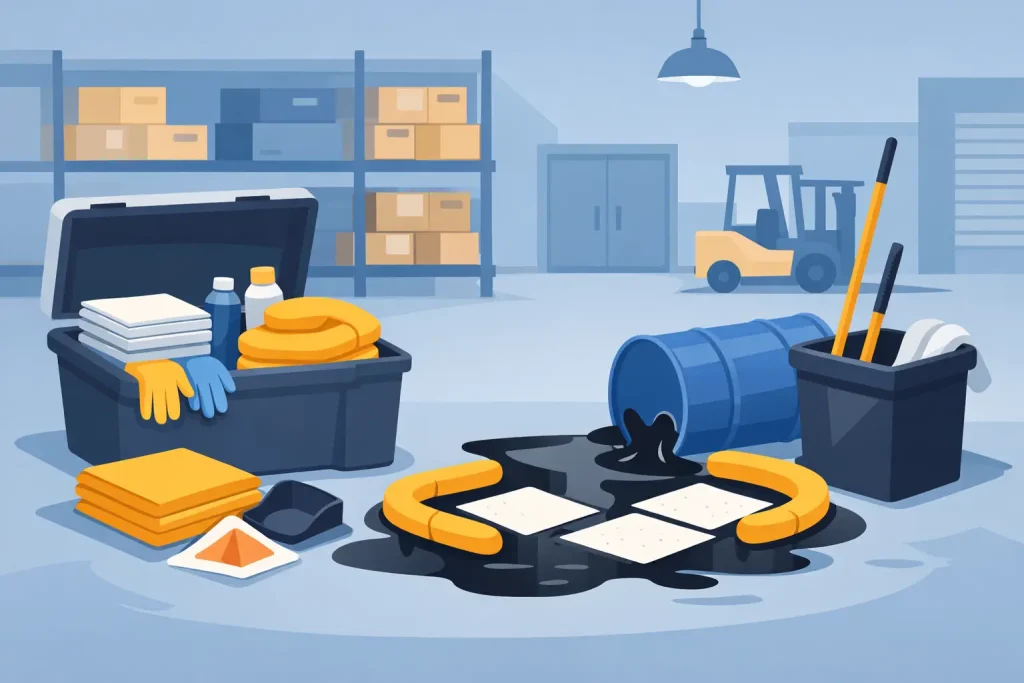
A leaking drum near the racking aisle can shut down picking, create slip hazards, and turn a routine shift into an incident report. That is why an oil spill kit for warehouse use is not a nice-to-have item. It is basic response equipment for keeping operations moving, protecting workers, and containing contamination before it spreads across floors, drains, and stock areas.
Why an oil spill kit for warehouse operations matters
Warehouses deal with more oil-related risks than many teams expect. Forklifts can leak hydraulic fluid. Delivery vehicles can leave behind engine oil. Stored machinery, lubricants, and maintenance supplies can drip during handling or transfer. Even a small spill becomes a bigger problem when it reaches a busy traffic lane or mixes with dust and packaging debris.
Oil spills differ from general liquid spills because they tend to spread quickly across smooth floors and remain dangerously slippery. If they are not contained early, they can move under pallets, into loading bay edges, or toward drainage points. That increases cleanup time, product loss, labor disruption, and safety exposure.
A proper kit gives your team a clear first response. Instead of sending staff to improvise with rags, cardboard, or unsuitable absorbents, they have the right materials ready on the spot. That saves time, reduces waste, and supports a more controlled cleanup.
What should be inside the spill kit
A warehouse oil spill kit should be built for petroleum-based liquids and hydrocarbon spills. In practical terms, that usually means absorbents that repel water while soaking up oil, fuel, and lubricants. This matters in covered and semi-open warehouse environments where moisture, washdown water, or rain blown into loading areas can complicate cleanup.
Most buyers should expect the kit to include absorbent pads for fast surface pickup, absorbent socks for stopping the spill from spreading, and absorbent pillows for heavier pooling around leaks or damaged containers. Disposal bags and basic PPE are also important because response does not end when the floor looks clean. Waste still needs to be collected and handled properly.
The exact mix depends on your site. A facility with forklift charging and maintenance zones may use more pads and pillows. A site with long aisle runs or loading bays may need extra socks to create barriers quickly. There is no single kit layout that fits every warehouse, which is why selection should be based on actual spill patterns, not guesswork.
Picking the right size for your warehouse
One of the most common buying mistakes is choosing a kit that is too small because the price looks attractive. A small kit may handle minor drips, but it will not be enough for a leaking drum, a damaged container during transfer, or a spill that spreads under movement equipment.
For low-volume risk points such as a small maintenance corner or a supervisor station, a compact 20L kit can make sense. It is easy to place close to the hazard and works well for quick response to minor leaks. For general warehouse coverage, 60L kits are a practical step up because they offer more absorbent capacity without taking up too much floor space.
If your site stores multiple oil containers, supports frequent equipment servicing, or has active loading zones, 120L and 240L kits are often the better choice. Larger kits are more suitable for high-risk areas because they give responders enough material to contain, absorb, and dispose of more significant spills without waiting for backup stock.
The right answer depends on the largest realistic spill you may face in that area, not the smallest one you hope for. Procurement teams should ask a simple question: if one container leaks during a busy shift, will this kit be enough to control it immediately?
Where to place spill kits in a warehouse
A spill kit only helps if people can get to it fast. Storing one in a locked room or at the far end of the building defeats the purpose. Placement should follow the actual flow of risk through the warehouse.
The best locations are usually near loading bays, decanting points, maintenance zones, forklift parking or service areas, and near storage locations for lubricants or oil-based products. If your warehouse has separate zones with different spill exposure, more than one kit is usually the smarter choice. One large kit in a central office area is less effective than several correctly sized kits placed near likely spill sources.
Visibility matters too. The kit should be easy to identify, easy to access, and not blocked by pallets or temporary stock. In high-traffic operations, delays happen when equipment is hidden behind daily storage overflow. That turns a preventable spill into a wider cleanup.
Match the kit to the floor and workflow
Warehouse conditions affect spill response more than many buyers realize. Smooth sealed concrete lets oil travel fast. Older or uneven flooring may trap fluid in cracks and joints. Narrow aisles can make cleanup harder because teams need to contain the spill without blocking every movement route.
Your workflow matters just as much. In a fast-moving distribution center, a spill in a picking aisle creates both a safety issue and a productivity issue. In a storage-heavy warehouse, the bigger concern may be oil spreading beneath palletized stock where cleanup becomes slower and more labor intensive.
This is why a practical oil spill kit for warehouse use should be chosen with your real operating environment in mind. The absorbents need to work for the type of oil handled, the likely spill volume, and the pace of the area where the incident may happen.
Compliance, housekeeping, and cost control
Many buyers start looking for spill kits after an incident, an audit finding, or a customer safety review. That is common, but waiting until then usually costs more. A spill can lead to downtime, wasted stock, cleanup labor, and avoidable injury exposure. The cost of a ready-to-use spill kit is minor compared with the cost of poor response.
Good spill preparedness also supports stronger housekeeping standards. When kits are available and stocked properly, staff are more likely to report and manage leaks early instead of working around them. That helps reduce repeat contamination and keeps storage and traffic zones safer.
From a commercial standpoint, standardizing your spill kit sizes across sites can also make purchasing easier. If one warehouse needs compact kits and another needs larger wheeled units, you can still build a simple response plan using a small number of stocked formats. That makes replenishment and budget control easier for procurement teams.
Do not forget replenishment
A spill kit is not a one-time purchase if it has been opened, partially used, or stripped of materials over time. Pads disappear. Socks get borrowed for small leaks. PPE goes missing. Then a real incident happens and the kit is no longer ready.
That is why inspections matter. Warehouse managers and EHS teams should check kits regularly to confirm that absorbents are present, packaging is intact, and used items have been replaced. A spill kit that looks full from the outside can still be missing the most important components.
For larger sites, it also makes sense to keep backup absorbent pads, socks, and pillows available for replenishment. This is especially useful when spill kits are used for frequent minor incidents rather than rare major ones.
When a general spill kit is not enough
Not every warehouse spill should be handled with the same absorbent type. If your site only deals with oils, lubricants, fuels, and hydrocarbon-based liquids, a dedicated oil kit is the right fit. But if you also handle corrosives, solvents, or mixed chemicals, you may need separate response equipment for those hazards.
This is where buyers should avoid the cheapest one-size-fits-all decision. A general kit may seem economical upfront, but it can be the wrong tool for the liquid involved. Choosing by hazard type is the safer and more practical approach.
Industrial suppliers such as FUMiKA typically offer multiple spill kit capacities and absorbent formats for exactly this reason. The goal is not to overcomplicate the purchase. It is to make sure the product matches the workplace risk so the response is fast and effective.
What smart buyers should look for
When comparing options, focus on absorbent type, capacity, ease of placement, and availability for repeat orders. Fast delivery matters because spill preparedness cannot wait weeks for stock. Price matters too, but only after confirming that the kit is suitable for the actual spill risk.
For many warehouses, the best purchase is not the biggest kit or the cheapest kit. It is the one that fits the spill source, the location, and the speed your team needs when something goes wrong. If you buy with that in mind, your spill response becomes simpler, safer, and easier to manage when the pressure is on.
A good spill kit does more than absorb oil. It protects workflow, reduces safety exposure, and gives your team a clear first move when every minute counts.