
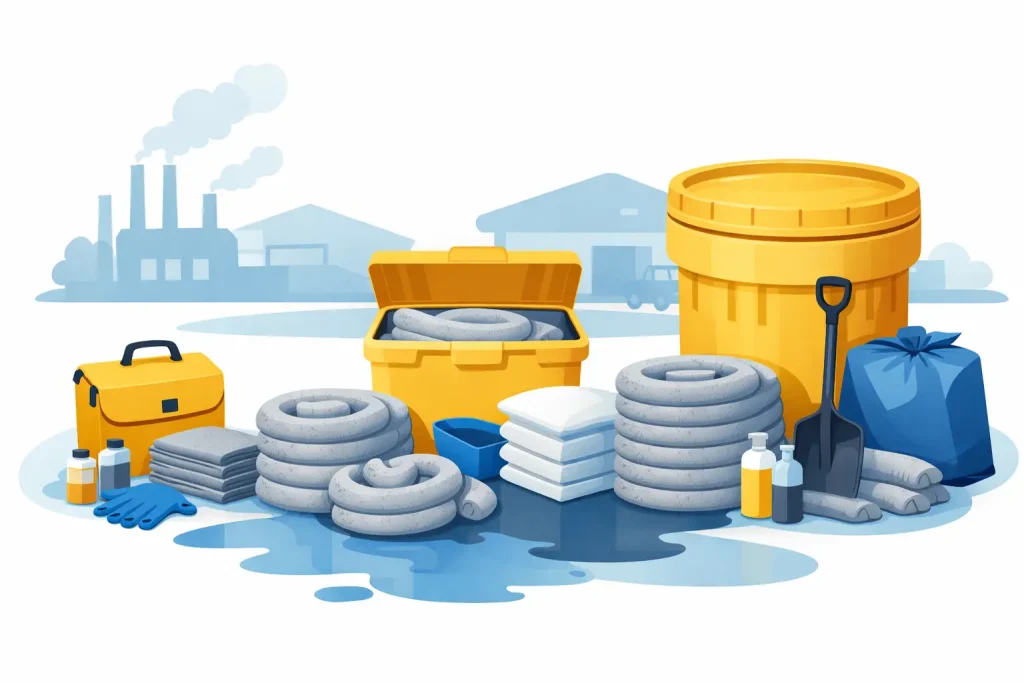
A spill kit that is too small does not save money when the first real spill overruns the absorbents, spreads across a walkway, and stops operations. If you are deciding how to choose spill kit size, the right answer starts with the actual spill risk on your site, not with the lowest-priced option on the page.
For warehouses, workshops, factories, labs, loading bays, and maintenance areas, spill kit sizing is a practical purchasing decision. You need enough absorbent capacity to control the most likely spill, but you also do not want oversized kits placed everywhere with no clear reason. The best size is the one that matches your fluid hazards, container volumes, response time, and layout.
How to choose spill kit size based on real spill risk
Start with the largest likely spill in each area. This is the most useful way to size a kit because spill kits are bought for incidents, not averages. If your maintenance corner stores small containers, a compact kit may be enough. If your loading area handles drums, IBCs, or bulk transfer, you need a larger response capacity nearby.
A common mistake is sizing a spill kit based on the smallest daily spill rather than the worst credible one. Small drips and minor leaks happen often, but spill kits are there for sudden hose failures, toppled containers, transfer mistakes, and equipment leaks that spread fast. If one damaged drum can release a large amount before operators react, your kit size should reflect that exposure.
Think in zones, not only at site level. A single facility may need different capacities in different locations. A lab bench area may suit a 20L kit, while a forklift battery charging zone, a chemical store, or a diesel transfer point may need 60L, 120L, or 240L capacity. Matching the kit to the hazard area is usually more cost-effective than buying the same size for every department.
Match spill kit size to container and storage volume
One practical rule is to look at what is stored, moved, or used in that area. If staff handle small bottles, pails, and maintenance fluids in limited quantities, a 20L spill kit often covers small incidents and first response. This size is usually suitable for service vehicles, small workshops, compact plant rooms, and low-volume handling points.
A 60L spill kit is a common choice for medium-risk areas. It suits workshops, warehouse aisles, equipment maintenance spaces, and areas where multiple containers are used but full drum failure is less likely. It gives a stronger response buffer without taking up too much floor space.
A 120L spill kit fits sites where larger leaks are possible and where response needs to be fast and visible. It is often used near drum storage, decanting points, transport yards, production areas, and larger maintenance facilities. If operations involve regular liquid handling and the consequences of spread are higher, this size is often the safer buy.
A 240L spill kit is usually the right choice for high-risk zones, bulk liquid storage, loading docks, marine areas, fuel handling, chemical stores, and industrial sites where a major spill can travel before isolation. It is also a good fit where one kit may need to support a wider operational zone.
This does not mean you always size the kit to capture a full container release by absorbency alone. In some environments, spill response also depends on bunding, spill pallets, drain protection, shutoff procedures, and fast isolation. But the kit still needs enough capacity to contain and absorb a realistic amount before the spill escalates.
Fluid type changes the right size decision
If you are working out how to choose spill kit size, do not separate size from absorbent type. Oil, coolant, solvent, chemical, and general maintenance liquids behave differently. A large kit with the wrong absorbents is still the wrong purchase.
Oil spill kits are designed for hydrocarbons and outdoor use where water may be present. Chemical spill kits are for aggressive liquids and unknown substances that need broader compatibility. General purpose kits are suitable for common water-based industrial fluids and non-aggressive liquids. The more hazardous the liquid, the less room there is for under-sizing.
Chemical areas usually justify more conservative sizing. Even a moderate spill can create safety, contamination, and evacuation issues. In those environments, buyers often choose one size up to create a stronger response margin. That extra capacity can make the difference between a controlled incident and a shutdown.
Consider how far a spill can spread before response starts
The same 20 liters on two different floors does not create the same risk. On a flat, contained surface with trained staff nearby, response is quicker and spread is limited. On a sloped loading bay, near drains, around traffic routes, or in a busy production area, the spill can travel before anyone opens the kit.
This is why layout matters. If the spill can reach a drain, doorway, machine base, or pedestrian lane in seconds, size up. If staff need time to fetch PPE, stop equipment, or isolate the source, size up again. A kit should match not only spill volume but also how much the situation can worsen in the first few minutes.
Distance is another factor buyers often miss. If the nearest kit is far from the hazard point, the effective response starts later. In many facilities, it is better to place multiple smaller or medium kits close to risk areas than rely on one large central kit. That improves response speed and reduces the chance of a spill spreading while someone goes searching for supplies.
Spill kit size and compliance are connected
Compliance decisions are usually site-specific, but the principle is simple. Your spill response equipment should be suitable for the materials handled and the realistic scale of incidents that could occur. If an inspector, auditor, client, or safety manager asks why a certain size was selected, you should be able to point to stored volume, spill history, floor conditions, and response planning.
That is a stronger position than saying the smaller kit was cheaper. Procurement teams are under pressure to control cost, but under-specifying spill control equipment often creates a larger cost later through cleanup, damaged stock, downtime, contractor callout, and reporting issues.
For many industrial buyers, the best purchasing approach is to standardize by risk tier. Low-risk points get 20L kits, medium-risk zones get 60L, drum and transfer areas get 120L, and bulk or high-consequence areas get 240L. That makes stocking, training, and reordering much easier.
A simple way to decide between 20L, 60L, 120L, and 240L
If your site handles minor leaks, mobile work, or low stored volume, 20L is usually the entry point. If the area sees regular fluid handling with moderate exposure, 60L is a practical step up. If drums, transfer points, or wider floor areas are involved, 120L is often the safer operational choice. If a spill could become serious fast, or if bulk liquids are present, 240L is the size to look at first.
There are trade-offs. Smaller kits are easier to place near work areas and cost less upfront. Larger kits provide a better safety buffer and reduce the risk of running short during a real incident. Most sites do not need only one size. They need the right mix.
That is where many industrial buyers get better value. Instead of overbuying large kits for low-risk corners or underbuying small kits for serious hazards, they map hazards by area and assign the right capacity to each zone. This creates faster response, cleaner storage, and more sensible spending.
If you are buying for multiple departments, keep replacement and restocking in mind as well. A spill kit is only useful when it is complete and ready to deploy. Standard sizes across similar risk areas simplify training and replenishment. For operations teams that need fast ordering, clear product selection matters as much as price.
FUMiKA supplies spill kits in 20L, 60L, 120L, and 240L capacities for industrial sites that need practical, ready-to-order spill response equipment without delay.
The best spill kit size is the one that fits the hazard before the spill happens. Buy for the real risk, place kits close to likely incident points, and give your team enough capacity to respond with confidence.